Authenticator ℠ App Authenticator ℠ App by Begamob

Google Account Two Step Verification: Complete Setup Guide

Protecting an online account with only a password is no longer the strongest security approach. Passwords can be reused, exposed in data breaches, guessed, or captured through phishing. Google account two step verification adds another layer between someone who knows your password and access to your account.

When you enable google account two step verification, signing in with a password can require an additional verification step. Depending on your security settings, Google can use Google prompts, Google Authenticator, passkeys, hardware security keys, backup codes, or other supported methods. Google currently recommends Google prompts when a user is not signing in with a passkey, while Authenticator remains useful because it can generate one-time verification codes without mobile service or an internet connection.

Many searches such as google account two factor, google account double verification, and 2 step verification for google account refer to this same security concept.

This guide covers the entire process—from turning security on to configuring Google Authenticator, managing multiple accounts, moving codes between devices, recovering lost access, and understanding what happens when google account 2 step verification off is selected.

1. What Is Google Account Two Step Verification?

How two-step authentication protects your account

Google account two step verification is Google’s implementation of two-factor or multi-step account protection. Once it is active, signing in with your password may require another method that verifies it is actually you.

Google describes 2-Step Verification as an extra layer of account security designed to protect the account if the password is stolen. After setup, users can sign in with a password and second step, or use a passkey where supported.

That second step might be:

  • a Google prompt;
  • an Authenticator verification code;
  • a hardware security key;
  • a passkey;
  • a supported phone verification method;
  • or a backup code.

This is why terms such as two step verification on google account, google account 2 step verification, and 2 step verification on google account generally describe the same core feature.

Is 2-Step Verification the same as MFA?

People searching set up mfa on google account often encounter the terms MFA, 2FA, two-factor authentication, and 2-Step Verification.

They are closely related, although the terminology can describe slightly different authentication architectures. For the average Google Account user, the important point is straightforward: google account two step verification adds another authentication requirement beyond simply knowing a password.

Google itself describes 2-Step Verification as two-factor authentication in its help documentation.

The second step provides useful protection because an attacker who obtains only your password may still lack the verification method associated with your account.

For most users wanting stronger google account authentication, enabling 2-Step Verification and registering multiple recovery options is a practical starting point.

2. How to Turn On Google Account Two Step Verification

Google Account Two Step Verification
How to Turn On Google Account Two Step Verification

Enable 2-Step Verification from Google Account settings

Setting up google account two step verification is done through your Google Account security settings.

Google’s current setup path is:

  1. Open your Google Account.
  2. Select Security & sign-in.
  3. Find How you sign in to Google.
  4. Select Turn on 2-Step Verification.
  5. Follow the on-screen instructions.

Google notes that work, school, or organization-managed accounts may have different policies, so users who cannot enable the setting may need to contact their administrator.

This is the correct area for people searching two step verification in google account, my google account 2 step verification, or the google account security page authenticator settings.

Once google account two step verification is enabled, additional authentication methods can be configured.

Choose your preferred second step

Google supports several verification methods.

Google prompts are currently recommended by Google for many users who choose to sign in with a password rather than a passkey. A prompt is sent to eligible devices already signed into the account, allowing the user to approve or reject the sign-in.

You can also configure an authenticator application.

This is useful when you want google account 2fa authenticator protection that does not depend on receiving an SMS or maintaining cellular service.

A good google account two step verification setup should not rely on only one device. Add recovery options while you still have access to everything rather than waiting until a phone is lost.

3. How to Add Google Authenticator to a Google Account

Connect Google Authenticator as a second step

Users searching add authenticator to google account or google authenticator for google account generally want Authenticator to generate the temporary codes used during sign-in.

After enabling google account two step verification, open the 2-Step Verification settings and select the option for Google Authenticator or an authentication application when it is available.

Follow Google’s displayed setup process and connect the Authenticator App to the account.

Once configuration is complete, Google Authenticator can generate verification codes even when the phone does not have cellular service or an internet connection.

That makes a google account google authenticator configuration particularly useful when traveling or when connectivity is unreliable.

A google authenticator gmail account setup does not create separate security specifically for Gmail. Gmail uses your Google Account, so protecting the underlying Google Account also protects access to Gmail associated with it.

Adding another entry inside Authenticator

Search queries such as google authenticator app add account, google authenticator add new account, google authenticator how to add account, and add account google authenticator can describe two different actions.

One is connecting a website to the Authenticator App by scanning its setup QR code.

The other is adding another Google Account to Authenticator for code synchronization.

Google currently supports multiple Google Accounts inside Authenticator. From the profile menu, users can select Add another account, choose or sign into the account, and allow codes to be saved there.

The same general concept applies to google authenticator add another account and google authenticator new account.

For add account to google authenticator iphone, the interface may look slightly different from Android, but Google Authenticator is also available for iPhone and iPad.

4. How Google Account Verification Codes Work

Google Account Two Step Verification
How Google Account Verification Codes Work

Where the verification code comes from

When google account two step verification requests an Authenticator code, Google Authenticator creates a temporary one-time code associated with the configured account.

A verification code for google account should only be entered into the legitimate sign-in process for the correct account.

Never send one to someone who contacts you asking for it. Google’s documentation explicitly warns users never to share verification codes and states that Google will not call users to ask them to verify a code.

Searches for verification code google account and my google account verification code may also refer to SMS codes or other Google verification challenges, so first check what method the sign-in page is requesting.

With google account two step verification, Google may choose different challenges depending on the account, device, and sign-in situation.

What if an Authenticator code does not work?

If an Authenticator code is rejected, first confirm that:

  • the code has not expired;
  • you selected the correct service;
  • you selected the correct account;
  • and your phone’s date and time are correct.

Google’s current Authenticator troubleshooting guidance specifically recommends checking that the code is entered before expiration, belongs to the right service and Google Account, and that the device time is synchronized correctly.

Do not repeatedly reset google account two step verification simply because one code failed.

If another verification method is available, use Try another way and then investigate the Authenticator setup once account access has been restored.

Get Authenticator App

Add an extra layer of protection to your online accounts with two-factor authentication. Generate secure verification codes and protect your accounts whenever you sign in.

Download Now

5. Using Google Authenticator With Multiple Accounts

Add multiple Google Accounts to Authenticator

Google Authenticator is not limited to one Google Account.

Google states that Authenticator can synchronize codes for multiple Google Accounts and display them on the same mobile device. Users can select their profile picture or initials, choose Add another account, and then select or sign into another Google Account.

This makes google account two step verification easier to manage for users with personal and secondary Google Accounts.

However, do not confuse a google authenticator account with the individual services listed inside the app.

Authenticator can contain codes for Google and many third-party services. The account used to synchronize those entries is separate from the account each individual code protects.

What about shared accounts?

The search google authenticator shared account often appears when several people need access to the same login.

Sharing passwords and Authenticator secrets between multiple people can make account security and recovery harder. Whenever possible, use individual user accounts, proper delegation, organizational access controls, or other official sharing features rather than distributing the same authentication credentials.

For google account two step verification, each person should ideally authenticate through the access system intended for them rather than sharing one person’s verification method.

Authenticator itself can display multiple accounts on one device, but that does not mean authentication secrets should be casually shared.

For users managing several legitimate accounts, label entries clearly and check the username before entering a code. This reduces the chance of accidentally entering the verification code for the wrong account.

6. How to Transfer, Remove, or Delete Authenticator Accounts

Google Account Two Step Verification
How to Transfer, Remove, or Delete Authenticator Accounts

Transfer codes to another device or Google Account

If you purchase a new phone, google account two step verification does not necessarily need to be configured from scratch.

When codes are synchronized to your Google Account, signing into that same Google Account within Authenticator on the new device automatically synchronizes those codes to the device.

If Authenticator is being used without a Google Account, Google also supports manual transfer.

The old device can generate one or more export QR codes through Transfer accounts → Export accounts. The new device then uses Transfer accounts → Import accounts to scan them. Manual transfer requires access to the old device.

For google authenticator transfer codes to another account, Google also currently allows Android users to edit an Authenticator entry and change the associated Google Account where that code is saved.

Remove an Authenticator code safely

Users searching google authenticator remove account, google authenticator how to remove account, or google authenticator how to delete account should distinguish deleting an Authenticator code from disabling 2FA on the service itself.

On Android, Google says users can swipe right on an Authenticator code to reveal the delete option. If the code is synchronized, deleting it also deletes the synchronized copy from other devices using that Google Account.

Deleting the Authenticator entry does not necessarily disable the protected website’s two-factor authentication.

Before removing anything, confirm that you can still sign into the service through another method or first disable/replace the old authenticator inside that service’s security settings.

This precaution is especially important when google account two step verification depends on the code you are about to remove.

7. Google Authenticator Without an Account vs Synced Codes

Using Authenticator without Google Account sync

Google authenticator without account is still supported.

Google says that when first opening Authenticator, users can select Use without an account. If codes were previously saved to Google Accounts, switching to this mode removes those codes from the Google Accounts and stores them locally on the device instead. Those codes will no longer be available on other devices through account synchronization.

This can affect how easily you recover google account two step verification if the device is later lost.

Device-only Authenticator storage puts greater importance on manually transferring codes before replacing the phone and maintaining backup authentication options.

Benefits of synchronized Authenticator codes

When codes are synchronized, Google says signing into the same Google Account within Authenticator on a new device automatically syncs those codes to it.

For many users, this simplifies device replacement.

Google’s current Authenticator best practices recommend synchronizing codes, enabling Privacy Screen, and registering additional forms of 2-Step Verification so that losing one method does not lock you out.

Privacy Screen can require a device PIN, pattern, or biometric verification before Authenticator is opened.

For a strong google account two step verification setup, consider both convenience and recovery. Cloud synchronization makes migration easier, while additional independent verification methods can provide another route if Authenticator becomes unavailable.

8. What to Do If You Lose Google Authenticator Access

Google Account Two Step Verification
What to Do If You Lose Google Authenticator Access

Recover a Google Account without Authenticator

A lost google authenticator account situation does not automatically mean the Google Account itself is lost.

If google account two step verification asks for a code you cannot generate, choose another verification method when available.

Google currently lists alternatives that may include:

  • another phone signed into the Google Account;
  • another registered phone number;
  • a previously saved backup code;
  • a hardware security key;
  • a passkey on another device;
  • or a previously trusted device.

Google backup codes are specifically intended for situations where normal 2-Step Verification cannot be completed. Google provides a set of 10 backup codes, and each becomes inactive after it is used. Generating a new set invalidates the previous set.

If none of your verification methods is available, use Google’s official account recovery process. Google notes that some 2-Step Verification recovery cases can require several business days while account ownership is verified.

What about Facebook or other services?

The query how to recover facebook account with google authenticator describes a Facebook recovery problem, not Google Account recovery.

Google Authenticator only generates the authentication code. Facebook controls the Facebook account and its recovery methods. Meta currently supports recovery login codes for users who previously enabled two-factor authentication and saved those codes.

The same principle applies to nintendo account google authenticator. Nintendo currently supports Google Authenticator for Nintendo Account 2-Step Verification and provides backup codes that can be used when Authenticator is unavailable.

For third-party services, always use the recovery process provided by that service rather than attempting to change google account two step verification.

9. How to Turn Off Google Account Two Step Verification

Disable 2-Step Verification

Users searching google account 2 step verification off generally want to remove the additional verification requirement.

Google currently provides the following process:

  1. Open your Google Account.
  2. Open Security & sign-in.
  3. Select 2-Step Verification.
  4. Sign in again if required.
  5. Select Turn off.
  6. Confirm the change.

Google warns that turning off google account two step verification removes an additional security layer and can make unauthorized account access easier.

Because of that, disabling the feature should not normally be the first response to inconvenience caused by a particular verification method.

Instead, consider changing the second-step method.

Clean up old backup codes and app passwords

When google account two step verification is disabled, Google recommends destroying previously saved backup codes.

Google also recommends reviewing and revoking App Passwords that are no longer needed.

If the reason you want to turn off 2-Step Verification is that Authenticator is difficult to use, consider replacing Authenticator with another supported verification method rather than eliminating the additional account protection completely.

For example, Google supports prompts, passkeys, security keys, Authenticator codes, and other account-dependent verification options.

The best choice depends on the devices you control and how you want to balance convenience, phishing resistance, and account recovery.

10. Best Practices for Google Account Two Step Verification

Keep at least one backup sign-in option

The most important rule for google account two step verification is simple: do not make one phone your only path into an important account.

Google specifically recommends registering additional forms of 2-Step Verification when using Authenticator.

Backup codes are particularly useful because they can be stored separately from your phone.

To create them, Google currently directs users to:

Google Account → Security & sign-in → 2-Step Verification → Backup codes.

A set contains 10 codes. Each code is single-use, and generating a new set invalidates the previous one.

Store them somewhere secure and separate from your Authenticator device.

Review your authentication methods regularly

A well-maintained google account two step verification configuration should evolve when your devices change.

Before replacing or factory-resetting a phone:

  1. Confirm that the new phone can access your Authenticator codes.
  2. Verify whether Authenticator synchronization is enabled.
  3. Test important account sign-ins.
  4. Confirm backup codes are available.
  5. Remove devices you no longer control.
  6. Update outdated verification methods.

If you use Authenticator without synchronization, manually transfer the codes before wiping the old device. Google requires the old device for its manual QR transfer process.

If the phone is lost rather than intentionally replaced, Google recommends securing the missing device immediately. When synchronized codes are involved, removing the lost device from the Google Account can help protect those codes. Unsynchronized codes may require visiting each protected service and replacing the old Authenticator relationship.

Final Checklist for Google Account Two Step Verification

A good google account two step verification configuration should provide stronger security without creating a single point of failure.

Start by opening your Google Account and enabling 2-Step Verification under Security & sign-in → How you sign in to Google.

Then choose appropriate authentication methods.

Google Authenticator is useful because it creates one-time verification codes without requiring cellular service or an internet connection. If you sign into Authenticator with a Google Account, the app can synchronize codes and make moving to a new device easier.

Users who prefer google authenticator without account can keep codes only on the device, but they should understand that manual migration requires access to the old phone.

For reliable google account two step verification, remember these principles:

  • enable more than one recovery method;
  • create backup codes;
  • never share verification codes;
  • protect Authenticator with device security;
  • verify Authenticator migration before wiping an old phone;
  • regularly review trusted devices and sign-in methods;
  • and use official account recovery if every second-step method becomes unavailable.

Whether you searched for google account two factor, google account 2 step verification, google authenticator for google account, or set up mfa on google account, the objective is ultimately the same: make it significantly harder for someone else to access your account while making sure you still have a secure recovery path.

Google account two step verification works best when it is treated as a complete security system rather than simply an extra code at login. Configure Authenticator carefully, maintain backup options, and review your Google Account security settings whenever you change phones or authentication methods.

Get Authenticator App

Add an extra layer of protection to your online accounts with two-factor authentication. Generate secure verification codes and protect your accounts whenever you sign in.

Download Now

Google Authenticator Lost: How to Recover Codes and Account Access

Seeing an empty Authenticator screen after changing phones can be alarming. The same is true when a phone is lost, damaged, factory-reset, or no longer accessible. Searches such as i lost google authenticator, google authenticator lost phone, or lost access to google authenticator usually come from the same urgent question: “Can I get my accounts back?”

In many cases, yes.

However, a google authenticator lost situation does not always have one universal recovery method. The correct solution depends on how Google Authenticator was configured before the phone disappeared.

Google Authenticator can currently synchronize verification codes with a Google Account. When synchronization was enabled, signing into the same Google Account inside Google Authenticator on a new device can restore synchronized codes automatically. Google also continues to support using Authenticator without a Google Account, but codes stored only on the device do not receive the same cloud synchronization protection.

This distinction is the key to solving most google authenticator lost cases.

If synchronization was not enabled and the old phone is unavailable, reinstalling Google Authenticator normally does not magically recreate every third-party 2FA token. Instead, you generally need another recovery method provided by the account you are trying to access: backup codes, another verification method, an already trusted device, or the service’s official account-recovery process.

This guide explains each situation from the easiest recovery path to the more difficult cases.

1. Google Authenticator Lost: What Actually Happens to Your Codes?

The first thing to understand about a google authenticator lost problem is that Google Authenticator is not the account itself. It is a tool that generates time-based verification codes for accounts that have been connected to it.

Your password and your Authenticator code are different

When a website uses two-factor authentication, your normal password acts as one factor and the temporary Authenticator code acts as another.

That means google authenticator lost codes does not necessarily mean your Facebook, Google, Discord, email, or another account has disappeared. Your account usually still exists; you have simply lost one of the methods used to prove that you are the legitimate account owner.

Google describes Authenticator as an app that generates one-time verification codes for websites and applications supporting authenticator-based 2-Step Verification. Those codes can be generated without cellular service or an internet connection.

This explains why searches such as google authenticator code lost, lost 2fa google authenticator, and google authenticator lost my codes should be treated as authentication-recovery problems rather than password-reset problems.

Synced codes and device-only codes behave differently

The most important question is:

Were your Authenticator codes synchronized with your Google Account?

If they were, the google authenticator lost problem may be much easier to resolve. Google states that when you sign into your Google Account within Authenticator on a new device, synchronized codes are automatically synced to that device.

If you intentionally chose “Use without an account,” your codes may have existed only on the device.

For someone searching google authenticator if phone lost or google authenticator when phone lost, this distinction should be checked before trying complicated recovery procedures.

2. Google Authenticator Lost Phone: Check Sync Before Doing Anything Else

Google Authenticator Lost
Google Authenticator Lost Phone: Check Sync Before Doing Anything Else

When dealing with a google authenticator lost phone situation, avoid immediately resetting every account. First install Google Authenticator on your replacement device and check whether your codes were synchronized.

Sign into the same Google Account

Install the official Authenticator App on the replacement device and sign in using the Google Account you previously used inside Authenticator.

If synchronization had been active, your previously synchronized entries should appear automatically. Google specifically states that signing into the Google Account in Authenticator on a new device syncs the stored codes to that device.

This is the easiest solution for queries such as:

new phone lost google authenticator,
got a new phone and lost google authenticator, or
google authenticator new phone lost old phone.

Also check whether Authenticator is displaying the correct Google Account. Google notes that codes can appear missing when a user has been signed out or when the codes are associated with another Google Account.

Do not confuse synchronization with manual transfer

Manual transfer is different.

Google’s manual transfer process requires access to the old device. The old phone exports the selected Authenticator accounts as QR codes, and the new phone imports them. Google lists the old device containing the codes as a requirement for manual transfer.

Therefore, if your situation is google authenticator lost old phone or lost my old phone google authenticator, you cannot rely on the old-device QR export process.

Instead, check Google Account synchronization first.

If the codes were not synchronized, continue with account-specific recovery methods.

Get Authenticator App

Add an extra layer of protection to your online accounts with two-factor authentication. Generate secure verification codes and protect your accounts whenever you sign in.

Download Now

3. How to Recover Google Authenticator When Your Phone Is Lost

A google authenticator lost incident becomes more serious when the physical phone itself has disappeared.

Your priorities are both recovery and security.

Try another verification method

If the missing Authenticator was protecting your Google Account, Google’s current 2-Step Verification guidance provides several alternative methods that may be available depending on what you configured previously.

These can include another phone already signed into the Google Account, another registered phone number, a previously saved backup code, a hardware security key, a passkey on another device, or a trusted device.

Therefore, when someone asks google authenticator what if i lost my phone, the best first response is not “reset Authenticator.” It is “check every recovery method already attached to the account.”

The same principle applies to lost my phone with google authenticator, i lost my phone with google authenticator, and google authenticator i lost my phone.

Recover each service separately when necessary

Google Authenticator can contain tokens for many independent services.

Imagine the lost phone contained codes for Google, Facebook, Discord, an email provider, and several other websites. Recovering your Google Account does not automatically reset the authentication configuration of every unrelated service.

If your Authenticator codes were not synchronized, Google recommends visiting each site where Google Authenticator was configured, removing the old authenticator association through that site’s available recovery process, and then linking the new device.

This is particularly important for 2fa google authenticator lost phone, google 2fa lost phone, and google auth lost phone searches.

Think of recovery as a list of individual accounts rather than one global Authenticator reset.

4. Google Authenticator Lost Codes Without the Old Phone

Google Authenticator Lost
Google Authenticator Lost Codes Without the Old Phone

The difficult version of google authenticator lost is:

  • the old phone is unavailable;
  • codes were not synchronized;
  • no manual transfer was completed;
  • and the login screen still demands a 2FA code.

Even in this situation, several legitimate recovery routes may remain.

Look for backup or recovery codes

Many services generate emergency codes when 2FA is enabled.

These codes are specifically intended for situations such as losing an authenticator device.

For Google Accounts, Google says backup codes can be used when you cannot complete the normal second verification step, including situations where your phone is unavailable.

Search secure places where you may previously have stored them, such as your password manager or personal recovery records.

Do not share a backup code with another person. A valid unused recovery code may provide access to the protected account.

Check devices where you are still signed in

A surprisingly useful recovery path after lost google authenticator app is an existing authenticated session.

You might still be logged in on:

  • a home computer;
  • a tablet;
  • another phone;
  • a browser profile;
  • or an official desktop application.

For Google Accounts, Google notes that a previously trusted device may allow access without the usual second verification step, after which verification methods can be managed.

If your search is i lost my google authenticator, lost my google authenticator, or i lost my google authenticator app, check existing sessions before logging out of anything.

A currently authenticated device may be your easiest route back into the account.

5. New Phone but Google Authenticator Lost on the Old Device

Changing phones creates one of the most common google authenticator lost scenarios.

Everything else may transfer correctly—photos, contacts, apps, messages—but 2FA codes appear missing.

If the old phone still works

If your previous device is still available, manual Authenticator transfer is straightforward.

Google’s official process allows the old device to export Authenticator accounts as QR codes and the replacement device to import them. The old device must be unlocked and contain the Authenticator codes being transferred.

This situation is different from google authenticator new phone lost old phone, because here you still possess both devices.

You can also avoid manual transfer when your codes are already synchronized through your Google Account.

If the old phone has already disappeared

For new phone lost google authenticator with no accessible old device, first sign into Authenticator with the same Google Account to test synchronization.

If nothing appears, verify that you selected the correct Google Account. Google notes that disappeared codes can sometimes be explained by being signed out or by the codes being stored under another Google Account.

If the codes truly existed only locally, manual export is no longer available.

At that stage, treat every third-party login independently.

Use recovery codes, another approved authentication method, an existing session, or the service’s official account-recovery system.

This is also the appropriate approach for queries such as google authenticator on lost phone and google authenticator app lost phone.

6. Recovering a Google Account After Losing Google Authenticator

Google Authenticator Lost
Recovering a Google Account After Losing Google Authenticator

When the protected account is the Google Account itself, a google authenticator lost issue has a defined recovery hierarchy.

Use “Try another way”

After entering your password, Google may make other previously configured verification methods available.

Google currently lists possible alternatives including another signed-in phone, a backup phone number, backup codes, a registered security key, a passkey, or a trusted computer.

That makes google authenticator login lost phone different from simply forgetting a password.

Resetting your password does not automatically prove ownership for the second authentication factor.

Use the legitimate verification options presented by Google.

Use Google Account Recovery when no second step works

If none of your registered second steps are available, Google directs users to its account-recovery process.

Google explains that the recovery flow may ask questions intended to confirm ownership of the account. For some 2-Step Verification recovery situations, verification can take several business days because of the additional security involved.

Avoid repeatedly creating new Authenticator entries or entering random codes. A new Authenticator installation cannot independently reproduce a secret that was stored only on a missing device.

For searches like google authenticator lost my phone, google authenticator lost, or google authenticator lost my codes, successful recovery depends on proving account ownership—not finding a universal replacement 2FA code.

Once access has been restored, remove outdated verification methods and configure the replacement device.

7. Google Authenticator Lost for Facebook, Discord, and Other Services

A major mistake during a google authenticator lost incident is assuming Google controls recovery for every token displayed inside its Authenticator app.

It does not.

The service that created the 2FA relationship controls the account-recovery policy.

Facebook and Discord recovery

For facebook google authenticator lost phone or facebook google authenticator lost, Facebook’s Help Center says users with two-factor authentication can use recovery login codes when they cannot use their phone. Facebook also supports other login-verification options depending on what was previously configured.

For discord google authenticator lost, Discord recommends first locating saved backup codes. If SMS MFA had previously been configured, that may also be available as an alternative verification method. Discord states that its support team cannot generate new backup codes for users who no longer have them.

The important lesson is consistent: prepare alternative authentication methods before a device disappears.

Financial and discontinued services require special care

Queries such as bybit google authenticator lost, degiro lost google authenticator, and olymp trade google authenticator lost involve account providers with their own identity and security requirements.

Do not use unofficial “2FA bypass” services or give authentication credentials to people claiming they can unlock an account. For regulated or age-restricted financial platforms, use only the provider’s official account-support process if you are eligible to use the service.

There is another unusual search term: hotbit google authenticator lost. Hotbit announced the shutdown of its centralized exchange operations in May 2023, with the historical withdrawal period ending in June 2023, so old Hotbit recovery articles should not be treated as instructions for an active exchange today.

The broader rule remains simple: Google Authenticator generates the code, but the protected service decides how access can be recovered.

8. What to Do If the Google Authenticator App or Codes Disappeared

Google Authenticator Lost
What to Do If the Google Authenticator App or Codes Disappeared

Not every google authenticator lost report involves a physically lost phone.

Sometimes the application is still installed, but the expected entries have vanished.

Check whether you are signed into the correct account

Google specifically recommends checking the profile icon if your Authenticator codes appear to have disappeared.

You may have been signed out of your Google Account or previously saved the codes under another Google Account. Switching between Google Accounts can reveal synchronized entries that initially appeared missing.

This is an important diagnostic step for someone thinking, i lost google authenticator even though the phone itself is sitting in front of them.

Before deleting or reinstalling anything, inspect the account state.

Reinstalling does not guarantee recovery

If codes were synchronized, reinstalling and signing into the correct Google Account can restore synchronized entries.

If codes existed only locally, uninstalling the Authenticator App can create a much more complicated recovery situation because the device-only information may no longer be available.

This distinction explains why searches for google authenticator lost codes and google authenticator code lost can have completely different outcomes for two people using apparently identical phones.

One person may have enabled synchronization.

The other may have used Google Authenticator without an account.

If nothing returns after confirming the correct Google Account, move to the recovery options offered by each affected website.

Do not repeatedly remove 2FA settings from accounts you can still access until you have established a working replacement verification method.

9. Secure Your Accounts After a Lost or Stolen Authenticator Phone

Solving a google authenticator lost problem is not only about getting back into accounts.

A missing device may also create a security risk.

Protect the lost device first

Google advises users whose device has been lost or stolen to ensure that Authenticator codes on the device cannot be accessed by another person.

Its current Authenticator guidance recommends using remote device-erasure options where available. If synchronized Authenticator codes are involved, Google also provides options for dealing with the device through the Google Account.

Google’s 2-Step Verification troubleshooting guidance additionally recommends signing out of a lost or stolen phone and changing the Google Account password.

Therefore, someone searching google authenticator lost my phone should think about both recovery and containment.

Replace the old authentication relationship

After you successfully recover each important account, review its security settings.

Remove the authenticator configuration associated with the missing phone if necessary and configure the new device through the service’s official security settings.

Also review logged-in sessions and remove devices you no longer recognize or control.

For people searching google authenticator if phone lost, the safest order is:

secure the missing device, regain access through legitimate recovery methods, replace the old 2FA configuration, and create backup methods for the future.

Avoid posting screenshots of QR setup codes or recovery codes online. Those values are security credentials and should remain private.

10. How to Prevent Another Google Authenticator Lost Problem

Google Authenticator Lost
How to Prevent Another Google Authenticator Lost Problem

The best solution to a future google authenticator lost emergency is preparation before anything goes wrong.

Google itself recommends synchronizing Authenticator codes to a Google Account, enabling Privacy Screen, and registering additional forms of 2-Step Verification to reduce the risk of being locked out.

Keep more than one recovery method

A strong setup does not depend on one phone.

Where supported, maintain an appropriate combination of:

  • synchronized Authenticator codes;
  • securely stored recovery codes;
  • another approved second-verification method;
  • a trusted device;
  • passkeys or security keys;
  • updated recovery contact information.

For Google Accounts specifically, backup codes are designed for occasions when normal 2-Step Verification is unavailable.

Store recovery information somewhere secure rather than only on the same phone that contains Authenticator.

Check your recovery setup before replacing a phone

Before selling, resetting, trading in, or factory-resetting your old phone, verify that Authenticator works on the replacement device.

A large percentage of searches framed as google authenticator lost old phone, got a new phone and lost google authenticator, or lost my phone with google authenticator can be avoided by completing this check before the old device is erased.

If you use device-only Authenticator storage, transfer the accounts while both devices are available.

If you use synchronized codes, confirm that the correct Google Account is signed in and that the expected codes appear on the new phone.

Then test several important accounts before wiping the old device.

Final Recovery Checklist for Google Authenticator Lost

When facing a google authenticator lost problem, the most important rule is not to panic and start changing random security settings.

First determine whether the codes were synchronized with your Google Account. If they were, install Google Authenticator on the replacement device, sign into the same Google Account, and check whether the entries return automatically. Google confirms that synchronized Authenticator codes can sync to a new device after sign-in.

If the codes were stored only on the old device and that phone is gone, manual transfer is not available because Google’s transfer process requires the old device. Instead, recover each protected account through its legitimate alternatives: backup codes, another registered verification method, a trusted session, or the service’s official recovery process.

If the phone was stolen rather than simply replaced, secure the device and account sessions as quickly as possible.

So whether your search was google authenticator lost my codes, google authenticator when phone lost, google authenticator lost phone reddit, or simply i lost my google authenticator, the recovery strategy comes down to three questions:

  1. Were your codes synchronized?
  2. Do you still have another legitimate verification method?
  3. What recovery options does the protected service provide?

A google authenticator lost event can be inconvenient, but losing the Authenticator app does not automatically mean losing every account protected by it. With synchronization, backup codes, alternate verification methods, and a properly secured recovery setup, you can significantly reduce the chance of being permanently locked out.

Get Authenticator App

Add an extra layer of protection to your online accounts with two-factor authentication. Generate secure verification codes and protect your accounts whenever you sign in.

Download Now

Google Authenticator MacBook: How to Use 2FA Safely on Mac

If you spend most of your day on a Mac, searching for google authenticator macbook seems completely logical. You sign in to Gmail, cloud platforms, social networks, work dashboards, developer services, and financial tools from your computer, so why should you have to reach for another device every time a six-digit verification code appears?

The answer is slightly more complicated than simply downloading another Mac app.

As of August 2026, Google’s official Authenticator listing on Apple’s App Store identifies compatibility with iPhone and iPad rather than listing a native macOS version. Google describes Authenticator primarily as an app that generates verification codes on your phone.

That does not mean MacBook users cannot use Google Authenticator.

In practice, a google authenticator macbook workflow normally consists of your Mac handling the login while Google Authenticator on an iPhone or iPad generates the second-factor code. Another option is to use Apple’s built-in Passwords system to generate compatible verification codes directly on the Mac.

Quick Answer

There is currently no official native Google Authenticator macOS app listed by Google. For most people, the safest setup is:

MacBook → enter password → iPhone/iPad Google Authenticator → enter verification code → sign in.

If you specifically want your verification codes available directly on your Mac, Apple Passwords can also store and generate verification codes for compatible accounts.

This guide explains every practical way to build a secure google authenticator macbook setup without confusing unofficial applications with Google’s actual product.

1. What Is Google Authenticator MacBook and Why Do Mac Users Search for It?

Google Authenticator is the second step, not the login itself

Google Authenticator is a two-factor authentication application. Instead of protecting an account with only a password, an enabled account asks for another credential—usually a temporary verification code.

The important distinction is that google authenticator macbook does not describe a special type of Google account or a separate authentication standard for macOS.

It usually describes a workflow.

You begin signing in on the MacBook, while another trusted device generates the temporary code required to finish that login.

Google says Authenticator codes can be generated even when the phone does not have an active network or cellular connection. That is one reason authenticator-based verification can be convenient when traveling or working in places with unreliable connectivity.

For example:

Step 1: Open a website in Safari or Chrome on your MacBook.
Step 2: Enter your username and password.
Step 3: The website requests a verification code.
Step 4: Open Google Authenticator on your phone.
Step 5: Enter the current code on the MacBook.

That is the standard google authenticator on macbook experience even though the Authenticator application itself may be running on another device.

Why MacBook owners want authentication directly on Mac

Convenience is the main reason users search for a google authenticator app for macbook.

Someone working eight hours a day on a Mac may authenticate dozens of sessions across email, analytics dashboards, development environments, admin panels, cloud tools, and company services.

Repeatedly unlocking a phone can interrupt the workflow.

There is also confusion created by Apple silicon. Apple allows some iPhone and iPad applications to run on Macs using Apple silicon when those apps are made available for Mac. Apple labels compatible software as “Designed for iPhone” or “Designed for iPad.”

However, availability is still determined app by app. You should not assume that every iPhone application automatically becomes a Mac application.

That distinction matters when researching google authenticator macbook.

Get Authenticator App

Add an extra layer of protection to your online accounts with two-factor authentication. Generate secure verification codes and protect your accounts whenever you sign in.

Download Now

📖 Read More Guides: Google Authenticator 2FA: Complete Guide to Two-Step Verification

2. Can You Download Google Authenticator Directly on a MacBook?

Google Authenticator MacBook
Can You Download Google Authenticator Directly on a MacBook?

Is there an official Google Authenticator for macOS?

This is the question that should be answered before discussing installation.

At the time of writing, Google’s official App Store listing for Google Authenticator identifies iPhone and iPad compatibility and does not list macOS compatibility in its compatibility information.

Therefore, if you search the Mac App Store for google authenticator for macbook and discover applications with similar names, do not automatically assume they are made by Google.

Always check the developer.

The official Google Authenticator listing identifies Google LLC as the seller.

A third-party application can implement the same type of one-time-password standard without being the official Google application. That does not automatically make the application unsafe, but it does mean you should evaluate it separately.

What about Apple silicon MacBooks?

Apple explains that Macs with Apple silicon can run certain iPhone and iPad apps when developers make those applications available on the Mac App Store. Compatible applications receive an appropriate compatibility label.

This creates an important rule for google authenticator macbook users:

Do not assume “my Mac can run iPhone apps” means “Google Authenticator is officially available for my Mac.”

Check the current official listing instead.

The practical situation can be summarized like this:

Option Runs on Mac? Official Google Authenticator? Best for
Google Authenticator on iPhone No Yes Most users
Google Authenticator on iPad No Yes Users with an iPad nearby
Native Google Authenticator macOS app Not currently listed No current Mac listing
Apple Passwords verification codes Yes No Apple-focused workflows
Third-party Authenticator App Depends on app No Advanced users after careful review

For most people searching google authenticator macbook, the first option remains the simplest because it keeps authentication on a separate trusted device.

3. How Google Authenticator Works With Your MacBook

Your Mac and authenticator do different jobs

Think of the system as two separate layers.

Layer 1: MacBook

Your MacBook connects to the service and submits your username and password.

Layer 2: Authenticator

Your authenticator provides the temporary code proving that you possess a previously enrolled authentication credential.

This separation is why google authenticator macbook works perfectly well without an official Mac application.

Suppose you are signing in to an account from Safari.

You enter:

[email protected]

Then your password.

The service may display:

Enter the 6-digit code from your authenticator app.

At that point, you open Google Authenticator on your phone and copy the current verification code into the browser.

The Mac does not need to generate the code itself.

Why the codes keep changing

Authenticator applications commonly use time-based one-time passwords. A shared setup secret and the current time are used to generate temporary codes.

The important thing for ordinary users is simple: the code changes automatically, so an old code cannot be treated like a permanent second password.

Google’s current Authenticator documentation also notes that the app uses the operating system’s time settings, and the older manual “time correction” setting is no longer available in version 7.0.

For a reliable google authenticator macbook workflow, therefore, your devices should have automatic date and time settings enabled.

This is especially relevant after:

  • traveling between time zones;
  • restoring a phone;
  • changing system time manually;
  • installing a major operating-system update;
  • moving authentication accounts to another device.

The concept is simple: your Mac handles the website, while the trusted authenticator handles the temporary credential.

📖 Read More Guides: Google Password Verification: Passwords, 2FA, Passkeys and Authenticator

4. How to Set Up Google Authenticator for a MacBook Login


Google Authenticator MacBook
How to Set Up Google Authenticator for a MacBook Login

Step 1: Install Google Authenticator on a trusted mobile device

Because the official application is currently intended for iPhone, iPad, and supported mobile platforms rather than native macOS, begin the google authenticator macbook setup on your trusted phone or tablet.

Download Google Authenticator from the official application store and verify that the publisher is Google.

Then open the application.

Google currently allows Authenticator users to synchronize verification codes by signing in to their Google Account. Google says those synchronized codes are encrypted both in transit and at rest.

You can decide whether synchronization is appropriate for your security model.

Step 2: Enable two-factor authentication on the account

On your MacBook, open the security settings of the account you want to protect.

Look for options such as:

  • Two-Factor Authentication
  • Two-Step Verification
  • Multi-Factor Authentication
  • Authenticator App
  • Verification App
  • TOTP

Select the authenticator option.

The website will usually display either a QR code or a setup key.

Step 3: Scan the QR code

Keep the QR code visible on the MacBook screen.

Open Google Authenticator on your phone and choose the option to add an account.

Scan the QR code shown on your Mac.

The account should then appear inside Google Authenticator with a temporary verification code.

This is one of the most convenient parts of a google authenticator macbook setup: the large MacBook display makes QR enrollment easy.

Step 4: Confirm the first verification code

Enter the current code from Google Authenticator into the confirmation field displayed on your Mac.

If accepted, two-factor authentication is active.

Do not stop there.

If the website provides recovery codes, save them securely. Google specifically recommends backup codes as another way to sign in when normal 2-Step Verification methods are unavailable.

A strong google authenticator macbook setup should never depend on one phone with no recovery path.

📖 Explore Articles:

Google MFA App: Complete Guide to Secure Multi-Factor Authentication

5. Google Authenticator on MacBook Air vs MacBook Pro

Google Authenticator MacBook Air workflow

There is no meaningful authentication difference between using a google authenticator macbook air setup and using another modern Mac model.

A typical MacBook Air workflow looks like this:

MacBook Air → website → password → authentication request → phone → Google Authenticator code → MacBook Air.

Whether you use Safari, Chrome, Firefox, or another compatible browser normally does not change how a standard authenticator code works.

For students, freelancers, travelers, and remote workers, this setup is especially practical because the phone remains a physically separate authentication device.

That separation can also be useful if your MacBook is shared temporarily for a presentation or connected to an external workstation.

Google Authenticator MacBook Pro workflow

Users searching for google authenticator macbook pro or a google authenticator app for macbook pro often have the same requirement but a heavier professional workflow.

A developer, administrator, designer, marketer, or business user may authenticate repeatedly throughout the day.

For these users, constantly switching between the MacBook Pro and phone can feel slower.

However, there is no separate official google authenticator for macbook pro product. The same Google Authenticator workflow applies.

You have two practical choices:

Security-separated setup

Keep Google Authenticator on a phone while working on your MacBook Pro.

Mac-centered setup

Use a trusted authentication solution that supports verification codes directly on macOS, such as Apple’s built-in Passwords verification-code feature.

The first is generally better when you deliberately want your second factor separated from the computer where you type your password.

The second emphasizes convenience.

So whether you use google authenticator macbook on an Air or Pro is less important than deciding where you want the second factor to live.

6. Three Ways to Get Authentication Codes While Using a Mac

Google Authenticator MacBook
6. Three Ways to Get Authentication Codes While Using a Mac

There is no single correct google authenticator macbook configuration. Different users have different priorities.

Here are the three main approaches.

Method A: Google Authenticator on your phone

This is the most direct interpretation of Google’s intended workflow.

Your MacBook handles login while your iPhone or Android device generates the verification code.

Advantages

  • Uses the official Google Authenticator application.
  • Keeps the second factor on another device.
  • Codes can work without an active cellular or network connection.
  • Easy to scan QR codes displayed on the Mac.
  • Familiar workflow across many websites.

Trade-off

You need your phone whenever authentication is requested.

For most people, this is the google authenticator macbook configuration I would choose first.

Method B: Apple Passwords verification codes on Mac

Mac users who want verification codes directly on their computer have a built-in alternative.

Apple’s Passwords app can store passwords, passkeys, and verification codes. Apple also supports setting up automatic verification codes for websites and apps that use two-factor authentication.

On supported Mac configurations, you can:

  1. Open the website’s security settings.
  2. Enable authenticator-based 2FA.
  3. Request a setup key.
  4. Open Passwords on the Mac.
  5. Select the relevant account.
  6. Choose the verification-code setup option.
  7. Enter the setup key.
  8. Use the resulting code to verify enrollment.

Apple also supports automatically filling verification codes on Mac.

This is not Google Authenticator, so it should not be marketed as an official google authenticator app for macbook.

It is simply another compatible way of generating authentication codes.

Method C: A third-party Authenticator App for macOS

A third category is a dedicated third-party Authenticator App that supports macOS.

These apps may provide features such as:

  • menu-bar access;
  • code search;
  • synchronization;
  • encrypted backups;
  • multiple vaults;
  • browser integration.

However, authentication secrets are highly sensitive.

Before using a third-party app as your google authenticator macbook replacement, investigate its developer, privacy practices, storage model, backup encryption, update history, and account-recovery process.

Do not install an app only because its name includes “Google Authenticator.”

📖 Read More Guides: Google Authenticator 2FA: Complete Guide to Two-Step Verification

7. How to Sync, Transfer, and Recover Google Authenticator Codes

Syncing Google Authenticator codes

Modern versions of Google Authenticator can synchronize verification codes through your Google Account.

Google explains that when you sign in to your Google Account inside Authenticator, your verification codes can synchronize across your devices.

This can make a google authenticator macbook workflow easier if you own multiple mobile devices.

For example:

iPhone → Google Account sync → iPad

You can then access your authentication codes from either enrolled mobile device.

Remember that “sync across devices” does not mean the codes automatically appear inside a native Google Authenticator application on macOS.

The official Mac compatibility question remains separate.

Transferring codes manually

Google also provides an account-transfer process.

On the old device, you can use:

Menu → Transfer accounts → Export accounts

Then select the accounts that should be transferred.

On the new device:

Menu → Transfer accounts → Import accounts

Then scan the transfer QR code.

This is useful when changing phones while keeping the same google authenticator macbook workflow.

Do the transfer before erasing or selling the old device.

Recovery deserves its own plan

One of the biggest authentication mistakes is planning for login but not recovery.

Ask yourself:

What happens if my phone disappears tonight?

If the answer is “I cannot access any important account,” your setup needs improvement.

Maintain suitable recovery options such as:

  • account backup codes;
  • another trusted authentication device;
  • passkeys where supported;
  • security keys where appropriate;
  • verified recovery email or phone methods offered by the service.

Google’s backup-code system is specifically designed to provide another sign-in path when normal second-step methods are unavailable.

A resilient google authenticator macbook setup therefore includes both authentication and recovery.

8. Security Best Practices for Using 2FA on a MacBook

Google Authenticator MacBook
Security Best Practices for Using 2FA on a MacBook

Treat the QR setup code like a password

When setting up google authenticator macbook, the QR code displayed during enrollment is sensitive.

It may contain the secret used to generate future verification codes.

Do not:

  • post a screenshot online;
  • send the QR code through unsecured chat;
  • store it in a public folder;
  • include it in screen recordings;
  • share it with coworkers unless account policy explicitly requires shared authentication.

Once setup is complete, close the enrollment screen.

Lock both devices properly

If your authentication flow uses both MacBook and phone, secure both devices.

For your Mac:

  • use a strong login password;
  • enable automatic screen locking;
  • keep macOS updated;
  • use biometric unlocking where appropriate;
  • review installed browser extensions;
  • avoid installing unknown security utilities.

For your phone:

  • use a device passcode;
  • enable Face ID or another biometric lock where available;
  • keep the operating system and authenticator app updated;
  • avoid leaving the phone unlocked.

The objective of google authenticator macbook is to add a second security barrier, not simply move another credential onto an unprotected device.

Consider the “same-device” trade-off

Storing both your password and your one-time verification codes on the same Mac can be highly convenient.

But convenience and separation are different security goals.

Consider these two layouts:

Separated

Password on MacBook + verification code on phone

Consolidated

Password + verification code both accessible through Mac ecosystem

The separated model means an attacker may need access to more than one device or security boundary.

The consolidated model reduces friction.

Neither decision should be made accidentally.

Choose the google authenticator macbook architecture that matches the sensitivity of your accounts.

For ordinary services, convenience may matter more. For administrator accounts, business systems, developer infrastructure, or valuable online accounts, stronger separation may be worth the extra step.

9. Google Authenticator MacBook Troubleshooting

Problem 1: “I can’t find Google Authenticator in the Mac App Store”

This is currently expected.

The official Google Authenticator App Store compatibility information lists iPhone and iPad rather than a native Mac requirement.

Therefore, do not keep installing similarly named applications expecting them automatically to be Google’s official google authenticator macbook product.

Instead, use the official application on a supported phone or tablet.

Problem 2: The code is rejected

First, wait for a new code and enter it carefully.

If multiple accounts appear in Google Authenticator, verify that you are using the code belonging to the correct website and account.

Also check automatic time settings on your authenticator device. Google’s current documentation says Authenticator relies on the operating system’s time setting.

A rejected code does not necessarily mean your entire google authenticator macbook setup is broken.

Problem 3: I changed phones

If you still have the old device, use Google Authenticator’s transfer function or sign in to the appropriate Google Account if you were using synchronization.

Google’s transfer workflow supports exporting accounts from one device and importing them on another using QR codes.

Do not erase the old device until you have tested the new one.

Problem 4: I lost my phone

Use one of the recovery methods configured with the account.

For a Google Account, backup codes can provide an alternative second step when regular verification is unavailable.

For third-party services, recovery procedures vary.

This is why a google authenticator macbook configuration should be tested before an emergency happens.

Problem 5: I want the verification code directly on my Mac

Use a compatible macOS verification-code solution rather than assuming Google provides a native Mac Authenticator.

Apple Passwords is one built-in option. Apple says the Passwords app can manage passwords, passkeys, and verification codes and can automatically fill verification codes on Mac.

This can provide the convenience users often expect when searching for google authenticator on macbook, while remaining clear that the feature is provided by Apple rather than Google Authenticator.

10. Which Authentication Setup Is Best for MacBook Users?

Google Authenticator MacBook
Which Authentication Setup Is Best for MacBook Users?

There are several ways to build a secure authentication workflow, but the right choice depends on what you value most.

Choose based on your priority

Use this quick decision map:

Want the official Google application?
→ Use Google Authenticator on your iPhone, iPad, or supported Android device.

Want authentication physically separated from your MacBook?
→ Keep Google Authenticator on your phone.

Want codes available directly on macOS?
→ Consider Apple Passwords verification codes or another carefully evaluated macOS authenticator.

Use a MacBook Pro for professional accounts?
→ The same options apply; there is no separate official google authenticator for macbook pro product.

Use a MacBook Air?
→ The standard phone-plus-Mac workflow works the same way.

Changing phones?
→ Transfer or synchronize your codes before wiping the previous device.

Worried about losing access?
→ Configure backup codes or another recovery factor now.

Final comparison

Priority Recommended approach
Official Google experience Google Authenticator on phone
Maximum convenience on Mac Apple Passwords verification codes
Separate second factor Phone + MacBook
Apple ecosystem integration Passwords + iCloud Keychain
Multiple mobile devices Google Authenticator synchronization
Custom Mac features Trusted third-party authenticator
Emergency recovery Backup codes + secondary method

The key lesson is that google authenticator macbook is best understood as an authentication workflow rather than a specific native Mac application.

Your MacBook is where the login happens.

Google Authenticator can remain on your phone or tablet and generate the temporary second-factor code. Google currently supports synchronization of Authenticator codes through a Google Account, while Apple provides its own verification-code system for users who want authentication integrated more deeply into macOS.

For most users, the straightforward configuration remains:

MacBook + official Google Authenticator on your phone + backup recovery method.

That arrangement is simple, easy to understand, and keeps the second authentication factor separate from the computer used to enter the password.

If your priority is speed, especially when you work all day on a MacBook Air or MacBook Pro, Apple’s verification-code tools can reduce the need to reach for a phone.

Just remember the distinction: an application that generates compatible 2FA codes on macOS is not automatically an official google authenticator app for macbook.

Before installing anything that handles authentication secrets, check who developed it and how those secrets are stored.

Ultimately, the best google authenticator macbook setup is not the one with the fewest clicks. It is the one that gives you an acceptable balance between security, convenience, device separation, synchronization, and recovery.

Configure those pieces correctly, and your MacBook can remain the center of your daily workflow without sacrificing the protection provided by two-factor authentication.

Get Authenticator App

Add an extra layer of protection to your online accounts with two-factor authentication. Generate secure verification codes and protect your accounts whenever you sign in.

Download Now

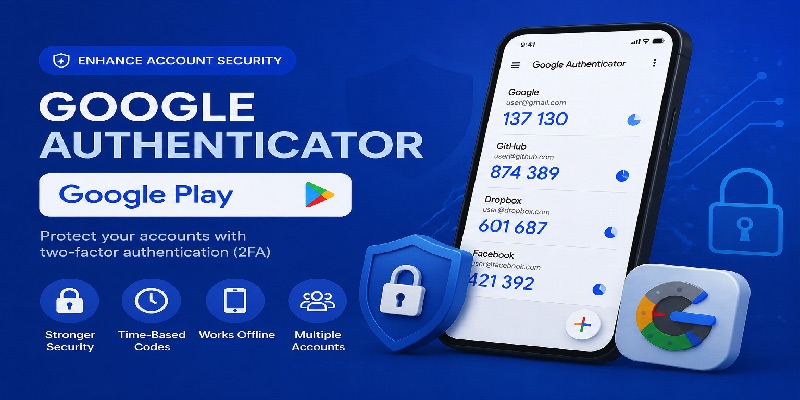
Google Authenticator Google Play: Download, Setup & 2FA App Guide

Passwords alone are no longer the strongest way to protect an online account. Email accounts, cloud services, social platforms, business tools, gaming profiles, and financial services increasingly support two-factor authentication, commonly called 2FA. One of the simplest ways to add this extra security layer on Android is through google authenticator google play.

Google Authenticator generates temporary verification codes that can be required after entering a password. According to Google’s current Google Play listing, these codes can be generated even when a phone does not have a network or cellular connection.

However, Google Authenticator is not the only option available. Android users searching for an authenticator app google play store can also encounter Microsoft Authenticator, Duo Mobile, Salesforce Authenticator, Steam Guard, and many third-party 2FA applications.

That creates an important question: which authenticator should you use?

This guide explains how google authenticator google play works, how to install and configure it, what to check before downloading an authentication application, and how Google’s solution compares with several popular alternatives currently available for Android.

1. What Is Google Authenticator Google Play?

When people search for google authenticator google play, they are usually looking for Google’s official Android application for generating verification codes.

Google Authenticator is designed to add another verification step to compatible accounts. Instead of relying entirely on a password, a service can ask for a temporary code generated on your phone.

What Google Authenticator does

The basic authentication flow is simple:

  1. Enter your username or email.
  2. Enter your password.
  3. The website requests a verification code.
  4. Open Google Authenticator.
  5. Find the corresponding account.
  6. Enter the temporary code displayed by the app.

The official google play authenticator listing explains that Google Authenticator can generate verification codes without an active cellular or internet connection. This is useful because code generation does not depend on receiving an SMS every time you sign in.

Google also supports transferring Authenticator accounts between devices using QR codes. Google’s support documentation describes an import process in which the new device scans a QR code generated by the previous device.

Google Authenticator is not your Google password

A common misconception is that installing google authenticator google play changes or replaces your Google Account password.

It does not.

Google Authenticator is a verification tool. The account or service itself determines whether 2FA is required and provides the QR code or setup key used to connect that account to the app.

This also means Google Authenticator can be used with compatible services beyond Google accounts.

When evaluating any Authenticator App, remember that the authenticator and the account being protected are two different components of the security process.

📖 Read More Guides: Google Authenticator 2FA: Complete Guide to Two-Step Verification

2. Why Download Google Authenticator From Google Play?

Google Authenticator Google Play: Download, Setup & 2FA App Guide
Why Download Google Authenticator From Google Play?

Searching for an authentication application can return many apps with similar names, icons, and descriptions. For this reason, the source of your download matters.

For Android users with access to Google Play, the safest starting point for google authenticator google play is Google’s official store listing.

Verify the developer before installing

Before tapping Install, check the application name and developer.

For Google Authenticator, the official Google Play listing identifies the application as Google’s Authenticator product.

Do not assume that every application containing words such as “Google,” “OTP,” “2FA,” or “Authenticator” is the official Google app.

Searching google authenticator play store may display alternative authenticator applications as well. Some can be legitimate products, but they are not necessarily created or supported by Google.

This is particularly important because an authenticator handles information connected to your account security.

Why the Play Store is convenient

Using google authenticator google play gives Android users a familiar installation process:

  • Find the application.
  • Review its developer information.
  • Check device compatibility.
  • Install it.
  • Receive future app updates through Google Play.

The same principle applies when downloading an authenticator app google play from another provider.

For example, Microsoft Authenticator, Duo Mobile, and Salesforce Authenticator all currently maintain Google Play listings.

Downloading an authenticator should therefore begin by confirming that you have located the intended app and its legitimate publisher rather than selecting the first similarly named search result.

📖 Read More Guides:

Google Account Two Step Verification: Complete Setup Guide

3. How to Download Google Authenticator on Android

Installing google authenticator google play is similar to installing other Android applications, but taking an extra moment to verify the listing can prevent mistakes.

Step-by-step installation

On an Android device:

  1. Open Google Play Store.
  2. Search for Google Authenticator.
  3. Locate the official Google application.
  4. Review the developer and app information.
  5. Tap Install.
  6. Wait for installation to finish.
  7. Open Google Authenticator.

You may also encounter the phrase google play authenticator when searching online. Make sure the search result ultimately points to the official Google Authenticator listing rather than an unrelated application.

Google’s current Play Store description states that the app supports multiple accounts and verification-code generation.

What to do before adding accounts

Installing google authenticator google play is only the first step. Before connecting important accounts, make sure you understand the recovery options provided by each service.

Depending on the website, these may include:

  • Backup codes
  • Additional authentication methods
  • Security keys
  • Recovery email
  • Recovery phone
  • Another registered device

Do not treat an authenticator as your only recovery plan.

If you replace or lose your phone without having another way to verify your identity, account recovery can become significantly more difficult.

When migrating between phones, Google’s official support documentation provides a QR-based transfer option for Authenticator accounts.

Preparing recovery methods before relying heavily on google authenticator google play can save substantial trouble later.

📖 Read More Guides: Google Authenticator 2FA: Complete Guide to Two-Step Verification

4. How to Set Up Google Authenticator After Installation

Google Authenticator Google Play: Download, Setup & 2FA App Guide
How to Set Up Google Authenticator After Installation

After installing google authenticator google play, you need to connect each account that you want the app to protect.

The exact website menus vary, but the overall process is similar across many services.

Enable two-factor authentication

First, sign in to the account you want to secure.

Look for settings such as:

  • Security
  • Two-Step Verification
  • Two-Factor Authentication
  • Multi-Factor Authentication
  • MFA
  • Authentication App

Select the option for an authenticator or verification-code application.

The service normally displays either a QR code or a setup key.

Open google authenticator google play, choose the option to add an account, and follow the on-screen setup process.

Scan the QR code

QR scanning is usually the fastest method.

The website displays a QR code containing the information required to configure the authenticator. Google Authenticator reads it and begins generating codes for the account.

Many services then ask you to enter one current code to confirm that setup succeeded.

Once confirmed, the account should appear inside the app.

Save recovery information

Do not finish the setup process without checking whether the service offers backup codes or another recovery method.

Store recovery information somewhere secure and separate from the phone running google authenticator google play.

For example, keeping the only copy of your recovery code as a screenshot on the same phone offers little protection if that phone becomes unavailable.

Google’s own transfer guidance also makes it possible to move Authenticator accounts from an old device to a new device by using the app’s account-transfer feature.

Get Authenticator App

Add an extra layer of protection to your online accounts with two-factor authentication. Generate secure verification codes and protect your accounts whenever you sign in.

Download Now

5. Google Authenticator vs Other Popular Authenticator Apps

There is no single authenticator that is ideal for every account and every organization.

Someone protecting a few personal accounts may have very different needs from an employee using enterprise identity systems.

The table below provides a practical comparison of several popular options found when researching alternatives to google authenticator google play.

App Main Use Verification Codes Push Approval Best For
Google Authenticator General 2FA Yes Service-dependent/not its primary model Simple personal 2FA
Microsoft Authenticator Microsoft + general MFA Yes Yes Microsoft personal/work/school accounts
Duo Mobile Duo Security + third-party 2FA Yes Yes Business and enterprise authentication
Salesforce Authenticator Salesforce MFA Yes Yes Salesforce users and organizations
Steam Mobile / Steam Guard Steam account security Steam-specific Yes Steam gamers

Google confirms that its authenticator can generate verification codes offline. Microsoft describes its Authenticator as supporting multi-factor and passwordless sign-in, while Duo states that Duo Mobile can generate passcodes and receive push notifications.

Salesforce Authenticator also supports push-based approval and denial of authentication requests.

Simplicity versus ecosystem integration

The main strength of google authenticator google play is simplicity.

If you primarily need temporary codes for compatible services, the app provides a focused workflow.

Microsoft Authenticator and Duo Mobile can make more sense when your employer or school already uses their respective identity systems.

Salesforce Authenticator is particularly relevant to Salesforce environments.

Steam Guard is different again because it is built specifically around Steam account security.

Therefore, choosing an Authenticator App should start with the systems you actually use rather than selecting an app based only on popularity.

6. Google Authenticator vs Microsoft Authenticator

Google Authenticator Google Play: Download, Setup & 2FA App Guide
Google Authenticator vs Microsoft Authenticator

Microsoft Authenticator is one of the most common alternatives people encounter while researching google authenticator google play.

Searches such as microsoft authenticator app google play, microsoft authenticator google play, and microsoft authenticator google play store all refer to Microsoft’s Android authenticator application.

Microsoft currently provides its Authenticator through Google Play for Android devices.

Where Google Authenticator is strong

Google Authenticator works well when the goal is straightforward code-based two-factor authentication.

Benefits include:

  • Simple interface
  • Multiple-account support
  • Offline code generation
  • QR-based account setup
  • QR-based account transfer

The ability to generate codes without network connectivity is explicitly documented on Google’s current Play listing.

For people who simply want an app that displays verification codes, google authenticator google play remains an easy option to understand.

Where Microsoft Authenticator differs

Microsoft Authenticator goes further into Microsoft’s identity ecosystem.

Microsoft says the app supports multi-factor authentication and passwordless sign-ins and includes additional management capabilities for Microsoft personal, work, and school accounts.

This makes the google play store microsoft authenticator app particularly relevant for Microsoft 365 or Microsoft Entra environments.

The choice is therefore not necessarily about which application is universally “better.”

Choose google authenticator google play if simple verification-code management matches your needs.

Choose Microsoft Authenticator when Microsoft’s authentication workflows, push approvals, or organizational requirements are important.

7. Duo Mobile and Salesforce Authenticator on Google Play

Enterprise users may encounter Duo or Salesforce rather than Google Authenticator.

Both currently have official Android listings on Google Play.

Duo Mobile

People searching google play duo mobile or google play store duo mobile are usually looking for Cisco Duo’s authentication application.

According to its current Google Play listing, Duo Mobile works with Duo Security’s two-factor authentication service, generates login passcodes, and can receive push notifications for one-tap authentication. It can also manage code-based 2FA for other compatible applications and web services.

This makes Duo especially useful when an employer, university, or organization already uses Duo authentication.

For general personal accounts, google authenticator google play may feel simpler, while Duo Mobile becomes more valuable when Duo Push is part of an organization’s login flow.

Salesforce Authenticator

A search for google play salesforce authenticator leads to another specialized authentication option.

Salesforce says its app provides multi-factor authentication and can send a push notification that lets users approve or deny account activity.

Salesforce’s support documentation also directs Android users to install Salesforce Authenticator from Google Play as part of its setup process.

For a company centered on Salesforce, this integration can be more important than choosing a general-purpose authenticator.

In other words, google authenticator google play is not automatically the best choice for every workplace. Your organization’s authentication requirements should determine which application you install.

📖 Read More Guides: Google Account Two Step Verification: Complete Setup Guide

8. Steam Guard and Authentication for Gaming Accounts

Google Authenticator Google Play: Download, Setup & 2FA App Guide
Steam Guard and Authentication for Gaming Accounts

Gaming accounts can also benefit from stronger login protection, but Steam handles authentication differently from a typical generic TOTP application.

Users searching for steam authenticator google play should look at Steam Guard inside Valve’s official Steam mobile application.

How Steam Guard works

The current Steam Android listing says Steam Guard provides two-factor authentication for Steam accounts.

It includes options such as:

  • Two-factor authentication
  • QR-code sign-in
  • Approve or deny sign-in requests
  • Trade and Market confirmations

Because these functions are closely integrated with Steam, users should generally follow Steam’s own authentication flow instead of assuming that google authenticator google play is a direct replacement.

Generic authenticator vs platform authenticator

This illustrates an important distinction.

A general authenticator is designed to work with many websites that support common authentication-code standards.

A platform-specific authenticator can provide additional features connected to that platform.

Steam Guard, for example, is tied to Steam login, authorized devices, and account actions.

Salesforce Authenticator is closely tied to Salesforce.

Microsoft Authenticator integrates deeply with Microsoft identity.

By comparison, google authenticator google play is attractive when you want a relatively simple application for managing verification codes across compatible services.

Before adding an account, always use the authentication method officially recommended by that service.

9. Using Authenticator Apps Without Google Play Services

Android is used on many types of devices, and not every Android device includes the same Google components.

This becomes especially important when researching microsoft authenticator without google play services.

Microsoft Authenticator requirements

Microsoft’s current troubleshooting documentation states that, on Android, using Authenticator for a work or school account requires push notifications to be enabled and requires Google Play Services and Google Play Store to be installed and enabled.

Therefore, users should not assume that every feature will work identically on a device without Google’s services.

This is an important distinction between generating a local authentication code and receiving a cloud-delivered push approval.

If your organization requires Microsoft push authentication, check device compatibility before depending on the app.

What about Google Authenticator?

Google’s Play listing states that Authenticator can generate verification codes even without a network or cellular connection.

However, “offline” and “without Google Play Services” are not necessarily the same thing.

Offline means the installed application can generate its codes without an active network connection.

A device that does not support Google Play at all presents a different installation and compatibility situation.

For this reason, google authenticator google play should be downloaded and used according to Google’s supported distribution and device requirements.

Avoid downloading unknown APK files simply because they claim to provide the same functionality.

10. Common Google Authenticator Problems and Solutions

Google Authenticator Google Play: Download, Setup & 2FA App Guide
Common Google Authenticator Problems and Solutions

Even a relatively simple application can cause confusion during device changes or account setup.

Here are several issues users may encounter with google authenticator google play.

The verification code does not work

If a service rejects a code, first confirm that you selected the correct account inside the authenticator.

Users managing many accounts sometimes accidentally enter a valid code belonging to another login.

Also verify that:

  • You are using the newest displayed code.
  • Your phone’s date and time are correct.
  • The account was configured with the correct QR code.
  • The service’s 2FA setup has been completed.

Do not repeatedly disable security controls simply because one code fails.

Instead, use the recovery or alternative authentication methods offered by the account provider.

You bought a new phone

Moving to another device requires more planning.

Google provides a transfer process in which Authenticator accounts can be exported from an old device and imported to another by scanning a QR code.

Complete the transfer while you still have access to the old device whenever possible.

After installing google authenticator google play on the new phone, verify important accounts individually before removing access from the old phone.

You cannot find the right app

Searching for authenticator app google play store produces multiple choices.

Check:

  • Exact application name
  • Publisher/developer
  • Description
  • Official website information
  • Whether your service specifically recommends that authenticator

For Google’s application, use the official google authenticator play store listing instead of choosing an unrelated app with similar branding.

11. Security Tips When Using an Authenticator App

Installing google authenticator google play improves your authentication setup only when the rest of your security practices are also sensible.

The authenticator should be one part of a broader account-protection strategy.

Protect the device itself

Because your phone may contain access to email, authentication codes, recovery information, and signed-in accounts, secure it with a screen lock.

Depending on your device, this may include:

  • PIN
  • Password
  • Fingerprint
  • Face authentication

Keep Android and important applications updated.

Avoid installing applications from suspicious sources or granting unnecessary permissions to unknown software.

Never share authentication codes

A verification code is meant to prove possession of your authentication device.

Do not send a current code to someone merely because they claim to represent technical support.

When using google authenticator google play, enter codes only into the legitimate website or application whose login you initiated.

Keep recovery options available

Before enabling 2FA on an important account:

  1. Review recovery methods.
  2. Save backup codes when offered.
  3. Add a backup authentication method if appropriate.
  4. Understand what happens if your phone is lost.
  5. Test your setup before signing out everywhere.

For accounts that support stronger phishing-resistant methods such as passkeys or hardware security keys, you may also want to evaluate those options alongside an Authenticator App.

The objective is not simply to install the greatest number of security applications. It is to create a login setup that is both secure and recoverable.

12. Is Google Authenticator Google Play the Right Choice?

For many Android users, google authenticator google play remains one of the simplest ways to begin using app-based two-factor authentication.

It is especially suitable when you want a focused application for generating verification codes across multiple compatible accounts.

Google’s official listing confirms important capabilities such as multiple-account management and verification-code generation without requiring an active network connection. Google also provides a QR-code-based process for transferring accounts to another device.

However, alternatives have advantages in particular ecosystems.

The microsoft authenticator app google play option is useful for people working heavily with Microsoft personal, business, or school identities. Microsoft supports MFA, push-based authentication, and passwordless sign-in scenarios.

Duo Mobile is particularly relevant when an organization uses Duo Security, while Salesforce Authenticator fits naturally into Salesforce authentication workflows.

Steam users should generally use Steam Guard through the official Steam mobile application for Steam-specific 2FA features.

The important point is that no authenticator should be selected only because its name appears first in search results.

When downloading google authenticator google play or another authentication application, confirm the official developer, understand how your accounts will be recovered, and follow the authentication method recommended by the service you are protecting.

If you mainly need straightforward time-based verification codes, google authenticator google play offers a clean and practical solution.

If your company relies on Microsoft, Duo, or Salesforce, their ecosystem-specific authenticators may provide a smoother workflow.

Whichever option you choose, combining a strong password with properly configured multi-factor authentication makes an account considerably harder to access using a stolen password alone.

For Android users beginning their 2FA setup, google authenticator google play is therefore a logical starting point—but the best authentication solution is ultimately the one that matches your accounts, devices, recovery plan, and security requirements.

Get Authenticator App

Add an extra layer of protection to your online accounts with two-factor authentication. Generate secure verification codes and protect your accounts whenever you sign in.

Download Now

FIDO Google: Complete Guide to Secure Login and FIDO2

Passwords have protected online accounts for decades, but passwords alone have become increasingly difficult to rely on. They can be reused, stolen through phishing websites, exposed in data breaches, or accidentally shared. This is one reason technologies based on the FIDO standards have become an important part of modern account security.

The term FIDO Google is commonly used by people searching for information about Google’s implementation of FIDO, FIDO2, passkeys, and hardware security keys. It is important to understand that FIDO Google is not the official name of a separate Google application. Instead, the phrase generally refers to Google’s support for authentication technology based on standards developed by the FIDO Alliance.

Google Accounts can use passkeys and compatible hardware security keys as authentication methods. FIDO2 combines WebAuthn with the Client to Authenticator Protocol, commonly called CTAP. These technologies use public-key cryptography instead of asking users to repeatedly enter shared secrets such as passwords or one-time verification codes.

This guide explains how FIDO Google works, how it relates to passkeys and FIDO2, how it differs from Google Authenticator, and when each security method makes sense.

1. What Is FIDO Google?

Understanding the FIDO standard

FIDO stands for Fast Identity Online. The FIDO Alliance develops authentication standards designed to reduce dependence on passwords while improving security and usability.

Modern FIDO Google authentication is closely associated with FIDO2 and passkeys. FIDO2 combines two important components:

  • WebAuthn, the web authentication standard used by browsers and websites.
  • CTAP, which allows authenticators such as security keys or nearby devices to communicate with a platform.

Together, these technologies allow users to prove their identity using cryptographic credentials rather than transmitting a password or reusable authentication secret.

What FIDO means for Google users

For a Google Account, FIDO Google can appear in several forms. A user may authenticate with a passkey stored on a trusted device, use the device’s fingerprint or screen lock to authorize a passkey, or use a compatible FIDO2 hardware security key.

Google officially supports passkeys for Google Accounts. When a passkey is used, the user proves both possession of the device and the ability to unlock it. Depending on account settings, this can replace entering a password or serve as a strong verification method.

Therefore, users searching for FIDO Google are usually looking for one of three things: passwordless Google login, FIDO2 security-key authentication, or information about Google’s passkey system.

📖 Read More Guides: Google Authenticator 2FA: Complete Guide to Two-Step Verification

2. How FIDO Google Authentication Works

FIDO Google: Complete Guide to Secure Login and FIDO2
How FIDO Google Authentication Works

Public and private keys

The biggest difference between FIDO Google authentication and traditional passwords is the way credentials are handled.

FIDO authentication relies on public-key cryptography. During registration, an authenticator creates a cryptographic credential associated with the website or service. The service receives information needed to verify future authentication, while sensitive private-key material remains protected by the user’s authenticator.

When the user signs in, the service sends an authentication challenge. The authenticator uses the protected credential to respond. The server then verifies that response.

The user may authorize this process using a fingerprint, face recognition, device PIN, pattern, or another local device-unlock mechanism. The biometric information itself does not need to be sent to Google simply to perform normal passkey authentication.

Passkeys are built on FIDO standards and are designed to provide a familiar device-unlock experience while replacing or supplementing passwords.

Why phishing becomes more difficult

A major benefit of FIDO Google is resistance to traditional credential phishing.

With a password, users can accidentally type their credentials into a fake website. Authentication codes can also potentially be entered into fraudulent login pages.

FIDO credentials work differently because credentials are associated with the legitimate website or relying party. A fraudulent domain cannot simply request the same credential as the legitimate service.

That characteristic makes FIDO-based authentication especially valuable for high-value Google Accounts, business accounts, creators, administrators, and anyone who regularly receives suspicious login messages.

Google itself describes passkeys and security keys as strong options for protecting accounts against phishing.

3. Why FIDO Google Is More Secure Than Password-Only Login

Passwords create reusable secrets

Traditional passwords are reusable secrets. If someone obtains the password, they may attempt to use it from another device or location.

Users also tend to reuse passwords across multiple websites, which increases the potential impact of a breach.

FIDO Google reduces this problem by introducing cryptographic authentication that does not require the same reusable secret to be transmitted during each login.

A passkey can also make authentication more convenient. Instead of remembering a complicated password, a user may approve login through the same mechanism used to unlock a trusted device.

Google currently allows eligible accounts to create passkeys and use them during sign-in.

Stronger protection against account takeover

The security advantage becomes particularly important when phishing is involved.

Imagine receiving an email containing a link to a convincing imitation of a Google login page. A traditional password can be typed into that page. A one-time code may also be copied into it if the victim believes the request is legitimate.

With FIDO Google, authentication is cryptographically connected to the legitimate service. This provides significantly stronger protection against common phishing techniques.

This does not mean that every other security method is useless. Google Authenticator, prompts, recovery information, and backup codes can all play important roles.

However, users seeking strong phishing resistance should understand why FIDO Google passkeys and security keys represent a different class of authentication from manually entered verification codes.

📖 Read More Guides:

Google Account Two Step Verification: Complete Setup Guide

4. How to Set Up FIDO Google on Your Google Account

FIDO Google: Complete Guide to Secure Login and FIDO2
How to Set Up FIDO Google on Your Google Account

Create a passkey

For many users, the simplest introduction to FIDO Google is a passkey.

Google allows users to manage passkeys through their Google Account security settings. The exact interface can change over time, but the general process is straightforward:

  1. Sign in to your Google Account.
  2. Open the account security settings.
  3. Find the passkey or sign-in options.
  4. Choose the option to create a passkey.
  5. Confirm your identity.
  6. Follow the device instructions to save the credential.

A compatible phone, computer, operating system, browser, or credential manager can store or manage the passkey. Google notes that passkeys may use familiar device-unlock methods such as fingerprints, face recognition, or screen locks.

Once configured, FIDO Google authentication may appear when you sign in on supported devices.

Add a FIDO2 security key

Some users prefer a dedicated physical security key.

Google supports security keys as part of account protection and 2-Step Verification. A compatible FIDO2 hardware security key can also be used for passkey functionality in supported configurations.

Hardware keys can be particularly useful for users managing important accounts because the authentication credential is tied to a physical device.

When setting up FIDO Google with a hardware key, consider registering more than one secure authentication option. A backup method can be useful if the primary key is lost or unavailable.

Google’s Advanced Protection guidance also recommends maintaining appropriate recovery options and, where suitable, an additional passkey or security key.

5. Google FIDO Login vs Google FIDO2 Login

What does Google FIDO login mean?

The phrase google fido login usually describes signing in to a Google Account using authentication based on FIDO standards.

In practical terms, that may mean:

  • Using a passkey on a phone.
  • Using a passkey stored through a credential manager.
  • Using a computer’s built-in authenticator.
  • Using a compatible hardware security key.

Therefore, google fido login is better understood as a general search term rather than the name of one specific Google login page.

In the context of FIDO Google, the important concept is that authentication can rely on cryptographic credentials instead of depending entirely on a typed password.

What does Google FIDO2 login mean?

The phrase google fido2 login is more specific because FIDO2 refers to the modern set of standards built around WebAuthn and CTAP.

FIDO Alliance documentation describes WebAuthn and CTAP together as FIDO2.

A google fido2 login may therefore involve a FIDO2 security key or another authenticator capable of participating in WebAuthn authentication.

For everyday users, the terminology is less important than the experience. Both searches often lead to the same practical goal: signing in securely without relying solely on a password.

Modern FIDO Google passkey functionality brings that experience to regular users without requiring them to understand every protocol behind it.

Get Authenticator App

Add an extra layer of protection to your online accounts with two-factor authentication. Generate secure verification codes and protect your accounts whenever you sign in.

Download Now

6. FIDO Google vs Google Authenticator

FIDO Google: Complete Guide to Secure Login and FIDO2
FIDO Google vs Google Authenticator

They are not the same technology

One of the most common misunderstandings surrounding FIDO Google is the assumption that Google Authenticator is part of FIDO authentication.

The two technologies solve similar account-security problems but operate differently.

Google Authenticator generates one-time verification codes for websites and applications that support authenticator-based 2-Step Verification. Google states that these codes can be generated even without an internet or cellular connection.

FIDO Google, by contrast, uses cryptographic authentication through mechanisms such as passkeys and security keys.

In simplified terms:

  • Password + Authenticator code = knowledge plus a temporary code.
  • FIDO/passkey authentication = possession of a cryptographic credential plus device authorization.

Which option should you use?

There is no requirement to treat the technologies as mutually exclusive.

For websites that support only TOTP verification, an Authenticator App remains useful. Google Authenticator can generate codes for many compatible accounts, not just Google Accounts.

For services supporting passkeys or hardware security keys, FIDO Google provides stronger resistance to phishing because authentication is connected cryptographically to the correct service.

Users who manage especially sensitive accounts should also consider recovery planning. Google provides backup-code options for situations where normal 2-Step Verification methods are unavailable.

The strongest configuration depends on the services you use, the devices you own, and the recovery methods available to you.

7. Using Google Authenticator With Outlook, Roblox, and iPad

Google Authenticator with Microsoft and Outlook accounts

People searching google authenticator outlook are usually trying to add an Outlook or Microsoft account to a third-party authenticator.

Microsoft supports two-step verification and authentication applications. Its documentation explains that verification codes can be used as part of account authentication, while Microsoft Authenticator also supports broader sign-in features for Microsoft accounts.

If a Microsoft security setup screen provides a standard authenticator-app QR code or setup secret that is compatible with your chosen authenticator, follow Microsoft’s current instructions when enrolling it.

The important distinction is that google authenticator outlook relates to one-time-code authentication, not directly to FIDO Google.

Google Authenticator for Roblox and iPad

Roblox officially supports authenticator-based 2-Step Verification. Its support documentation lists Google Authenticator among apps that can be used for this purpose.

When users search google authenticator for roblox or google authenticator roblox, they are generally trying to scan the Roblox 2-Step Verification QR code and then enter the temporary code generated by the authenticator.

Roblox has also introduced stronger phishing-resistant options for certain enhanced-security configurations, including passkeys or hardware security keys.

For google authenticator ipad, Google’s own support documentation includes instructions for iPhone and iPad users and confirms that Google Authenticator can generate verification codes for supported services.

When downloading the app, verify that you are looking at the genuine application rather than relying only on a familiar-looking google authenticator icon

📖 Read More Guides: Google Authenticator 2FA: Complete Guide to Two-Step Verification

8. Is Online Google Authenticator Available?

FIDO Google: Complete Guide to Secure Login and FIDO2
Is Online Google Authenticator Available?

Be careful with web-based OTP generators

Searches for online google authenticator have become common because users often want to access authentication codes from a desktop browser.

However, this requires caution.

As of August 2026, Google’s official Authenticator documentation describes the Google Authenticator application for supported mobile environments, including Android and iPhone/iPad. Google does not document a standalone official browser-based Google Authenticator service comparable to the mobile app.

Therefore, a website presenting itself as a google authenticator app online should not automatically be assumed to be operated by Google.

Entering a TOTP secret key into an unknown website can undermine the security benefit of two-factor authentication because that secret is what generates future verification codes.

Better desktop alternatives

If your real goal is convenient computer authentication, FIDO Google may offer a better solution than searching for a browser-based OTP generator.

Supported desktop browsers and operating systems can participate in passkey authentication. Hardware security keys can also work with compatible computers.

This allows FIDO Google authentication without copying temporary six-digit codes between devices.

If a service requires TOTP specifically, use a trusted authenticator solution supported by that service rather than uploading authentication secrets to random websites.

The lack of an official online google authenticator should therefore not be viewed as a limitation of Google’s passkey ecosystem. The two approaches are designed for different authentication workflows.

9. FIDO Google and Google Authenticator on Linux

Using FIDO authentication on Linux

Linux users sometimes search for google authenticator linux when they actually need one of two different things: a desktop TOTP manager or FIDO authentication.

For FIDO Google, Linux can participate through compatible browsers, operating-system capabilities, passkey providers, and hardware authenticators.

FIDO2 supports external authenticators through CTAP, while WebAuthn provides the browser-facing authentication interface. FIDO documentation describes transports including USB, NFC, and Bluetooth depending on the authenticator and implementation.

That makes a physical security key particularly useful for users who regularly move between Linux, Windows, macOS, or other environments.

Is there an official Google Authenticator Linux app?

Users searching google authenticator on linux or google authenticator for linux should distinguish official Google software from third-party implementations.

Google’s consumer Authenticator documentation focuses on its mobile application rather than providing a standard official Google Authenticator desktop application for Linux.

Third-party software may support the same TOTP standard, but users should evaluate such software carefully before importing authentication secrets.

For Google Account authentication specifically, FIDO Google may be a cleaner desktop option because a FIDO2 security key or compatible passkey workflow avoids storing TOTP secrets inside an additional desktop application.

In other words, google authenticator linux and FIDO2 solve different problems. Determine whether the website requires a one-time code or supports a passkey/security key before choosing a solution.

📖 Read More Guides: Google Account Two Step Verification: Complete Setup Guide

10. FIDO Google for Gemini, YouTube, and Google Services

FIDO Google: Complete Guide to Secure Login and FIDO2
FIDO Google for Gemini, YouTube, and Google Services

Gemini security comes from the Google Account

A search such as gemini google authenticator can give the impression that Gemini has a separate Google Authenticator system.

For most Gemini functionality requiring authentication, the important security layer is the Google Account used to access the service. Google’s Gemini documentation states that users need a Google Account for additional Gemini features and saved activity.

Therefore, protecting that Google Account with FIDO Google, a passkey, 2-Step Verification, and appropriate recovery options also helps protect access to Gemini associated with the account.

You normally do not need a separate “Gemini Authenticator” account simply because you use Gemini.

This is another reason FIDO Google should be understood at the Google Account level rather than as an individual security tool installed separately for every Google service.

Protecting YouTube with stronger authentication

The same concept applies to google authenticator youtube searches.

A YouTube channel is connected to a Google Account, so strengthening the Google Account strengthens the authentication protecting channel access.

YouTube’s current security guidance recommends 2-Step Verification and identifies passkeys as providing strong protection against phishing. It also lists security keys, Google prompts, Google Authenticator, phone verification codes, and backup codes as available types of verification with different security characteristics.

For creators, channel managers, or accounts with valuable content, FIDO Google passkeys or security keys can therefore be particularly important.

A traditional authenticator code remains useful, but passkeys provide stronger resistance against login pages designed to steal passwords and OTP codes.

11. Best Practices for Using FIDO Google Securely

Combine strong authentication with recovery planning

Setting up FIDO Google is only one part of account protection.

A strong account should also have a recovery strategy. Losing a phone, security key, or computer should not permanently lock the legitimate owner out of the account.

Google allows users to configure recovery information and provides backup-code functionality for certain 2-Step Verification situations.

Consider the following practices:

  • Create passkeys only on devices you control.
  • Protect every device with a secure screen lock.
  • Remove passkeys from devices you no longer own.
  • Consider keeping a backup hardware security key for important accounts.
  • Maintain current recovery information.
  • Store backup codes securely.
  • Review Google Account security settings periodically.

The goal is not simply to enable FIDO Google, but to build an authentication system that remains both secure and recoverable.

Do not approve unexpected authentication attempts

Passkeys reduce phishing risk, but users should still pay attention to unexpected login activity.

Do not authorize a sign-in simply because a prompt appears on your device. Confirm that you actually initiated the login.

Likewise, never send authenticator codes, backup codes, passwords, or security-key information to someone who contacts you unexpectedly.

If you use an Authenticator App, remember that a verification code should be entered only into the legitimate service for which the code was generated.

For high-value accounts, FIDO Google provides its greatest benefit when combined with good device security, careful recovery planning, and awareness of suspicious login attempts.

12. Troubleshooting FIDO Google Login Problems

Passkey or security key is not appearing

If FIDO Google does not appear as an authentication option, first verify that the passkey or security key has actually been registered with the correct Google Account.

Also check whether:

  • You are signing in to the correct Google Account.
  • Your device has a screen lock configured.
  • Your browser and operating system support the required authentication capability.
  • The hardware security key supports the required FIDO2 features.
  • The credential is stored in the credential manager you are currently using.

Google notes that creating a passkey on a hardware security key requires a key supporting the FIDO2 protocol.

For older security keys registered before Google’s expanded passkey support, Google’s documentation also notes that some users may need to remove and re-add the key before creating a passkey on it.

What happens if you lose your device?

Losing the device containing your FIDO Google passkey does not automatically mean that the Google Account is lost.

The available recovery process depends on your existing account configuration. You may have another passkey, another registered security key, a recovery method, or another verification step.

This is why recovery options should be configured before an emergency occurs.

For Google Authenticator users, backup codes can also help when normal verification methods are unavailable. Google specifically describes backup codes as an alternative when users cannot obtain their usual 2-Step Verification codes.

For critical accounts, avoid relying on a single device. The most resilient FIDO Google setup includes strong authentication plus at least one carefully protected recovery path.

Final Thoughts

FIDO Google represents an important change in how users protect their Google Accounts. Instead of depending entirely on passwords or manually entered verification codes, FIDO-based authentication uses cryptographic credentials designed to make phishing and credential theft substantially harder.

Passkeys have made this technology much easier for ordinary users. A fingerprint, face unlock, device PIN, or hardware security key can authorize authentication without forcing the user to remember another complex password.

At the same time, FIDO Google should not be confused with Google Authenticator.

Google Authenticator remains useful for services that rely on time-based verification codes. FIDO2, passkeys, and security keys use a different architecture and provide stronger protection against many phishing attacks.

Users interested in google fido login or google fido2 login should begin by checking the security settings of their Google Account and reviewing the available passkey and security-key options.

For services such as Outlook or Roblox, authenticator codes may still be relevant. For Google services such as Gemini and YouTube, protecting the underlying Google Account with FIDO Google can provide a stronger authentication foundation.

Ultimately, the best security configuration is not about choosing one tool for every situation. Use FIDO Google where passkeys or FIDO2 security keys are supported, use trusted authenticator-based verification where TOTP is required, maintain secure recovery options, and keep control of the devices that hold your credentials.

As passwordless authentication becomes more widely supported, FIDO Google provides a practical path toward faster sign-in, stronger phishing resistance, and a more secure Google Account.

Get Authenticator App

Add an extra layer of protection to your online accounts with two-factor authentication. Generate secure verification codes and protect your accounts whenever you sign in.

Download Now

Google Authenticator App Store: Download, Setup & Best Apps

When people search for google authenticator app store, they are usually trying to do one of three things: find the official Google Authenticator app for iPhone, understand whether it is worth using, or compare it with other two-factor authentication apps. All three questions matter because an authenticator is not just another utility. It can become one of the most important security tools on your phone.

Passwords are still the first line of defense for most online accounts, but a password alone may not be enough. If a password is exposed through phishing, reuse, a data leak, or another compromise, two-factor authentication can add another barrier. The google authenticator app store listing gives iPhone and iPad users access to Google’s official authenticator, which generates verification codes that can be used as a second sign-in step.

This guide explains the role of Google Authenticator, why an authenticator app can be useful, how to download and configure it on iPhone, and how it compares with several major alternatives currently available on the App Store. For readers arriving through a google authenticator app store search, the goal is to make the download decision and setup process clear. It also covers migration, backup, recovery, and practical security habits so you can choose an authenticator with fewer surprises later.

1. What Google Authenticator App Store Means for iPhone Users

The official iOS listing matters

The phrase google authenticator app store refers to the official Google Authenticator listing distributed through Apple’s App Store. For iPhone users, the safest starting point is to verify the developer name and app identity before installing. This is especially important because searches for authentication tools can display many similarly named apps.

Google Authenticator is published by Google LLC. Its current App Store description says the app adds a second verification step to online accounts and can generate verification codes on the phone even when there is no network or cellular connection. It also supports syncing Authenticator codes to a Google Account and across devices.

That combination makes the google authenticator app store version useful both for everyday sign-ins and for users who travel, work remotely, or sometimes operate without reliable connectivity.

What the app actually does

After you enable two-factor authentication on a compatible account, that service typically provides a QR code or setup key. You add that account to the authenticator, and the app begins generating short-lived verification codes. When the service asks for a second factor during login, you enter the current code.

The google authenticator app store download is therefore not a replacement for your password. It works alongside the account’s existing sign-in process. The main benefit is that someone who learns your password may still need access to your current verification factor before they can complete a protected login.

Some people also search the typo 2google authenticator in app store when they are trying to locate the official download. Regardless of the query used, verify that you are installing the listing published by Google LLC rather than choosing an app only because its icon or name looks similar.

📖 Explore Articles: Google Authenticator: Complete 2FA Setup & Security Guide

2. The Role of Google Authenticator in Account Security

Google Authenticator App Store: Download, Setup & Best Apps
The Role of Google Authenticator in Account Security

Adding a second sign-in factor

The core role of the google authenticator app store app is to support two-step or multi-factor sign-in. Instead of relying only on something you know, such as a password, a protected service asks for additional proof.

With a time-based authenticator, that additional proof is commonly a temporary code generated on a device you control. Two-factor authentication is designed to add a security layer beyond the username-and-password combination.

For anyone evaluating google authenticator app store, this matters because passwords can fail in several ways. People may reuse them across sites, enter them into fake login pages, or choose weak passwords that are easier to guess. Even a strong password can potentially be exposed during a compromise.

An authenticator adds another checkpoint so that possession of the password by itself may not be sufficient.

Why offline code generation is useful

One practical advantage highlighted in the google authenticator app store listing is offline code generation. The app can generate verification codes without a mobile-data or Wi-Fi connection.

That is useful on flights, while roaming, in buildings with poor reception, or during temporary network outages.

For users who manage many accounts, the app can also serve as a single place for multiple verification entries. Google’s current support documentation describes options for syncing codes with a Google Account, transferring accounts, organizing codes, and enabling a Privacy Screen that requires device verification before the app can be opened.

The google authenticator app store option is therefore best understood as a compact security utility: it stores or synchronizes authenticator entries, generates temporary codes, and helps you complete the second step of supported sign-ins.

It does not make an account invulnerable, but it can strengthen an account compared with relying on password-only access.

3. Why Use an Authenticator Instead of SMS Alone?

Greater separation from your phone number

A major reason users search google authenticator app store is that they want an alternative to receiving login codes by text message.

SMS can be convenient, but it depends on access to a phone number and the cellular messaging system. An authenticator-generated code is produced inside the app and does not require an incoming text message.

Apps such as Google Authenticator and Authy generate time-based one-time passcodes directly on the device instead of depending on SMS delivery.

That separation can be particularly helpful when mobile service is unavailable or when a user changes carriers.

For accounts that support multiple second-factor methods, an authenticator can also be combined with backup codes or another recovery method so that you do not rely on one authentication path.

Faster everyday sign-ins

The google authenticator app store app can also be convenient because the verification code is already available when you open the app. You do not have to wait for a text message to arrive.

For frequent logins, that can make two-factor authentication less disruptive.

Even with the convenience of google authenticator app store, there are still tradeoffs. If you lose the device and have not planned for recovery, you may have difficulty accessing protected accounts.

That is why setup should include backup codes, alternate recovery methods, or secure synchronization when the app supports it. Google specifically provides backup codes for situations in which you lose your phone or cannot use your normal second verification method.

For many users, the google authenticator app store choice is most valuable when it is part of a broader security setup: unique passwords, a password manager, 2FA, recovery information, and careful handling of QR codes and setup keys.

The authenticator is important, but the recovery plan is equally important.

📖 Read More Guides: Google Authenticator 2FA: Complete Guide to Two-Step Verification

4. How Google Authenticator Works on iPhone

Google Authenticator App Store: Download, Setup & Best Apps
How Google Authenticator Works on iPhone

QR codes, setup keys, and rotating codes

After downloading google authenticator app store, you normally connect an online account by scanning the QR code shown in that service’s security settings.

The QR code contains the information the authenticator needs to generate the appropriate time-based codes. Some services also provide a manual setup key if camera scanning is unavailable.

With google authenticator app store configured, the account appears in the app with a verification code that changes periodically.

When the website or app asks for a 2FA code, open Google Authenticator, locate the correct account, and enter the current code before it expires.

The workflow is intentionally simple: open the authenticator, locate the account, and use the current verification code.

Syncing and transferring accounts

A modern advantage of the google authenticator app store experience is that Google supports saving Authenticator codes to a Google Account.

Google’s support documentation also provides a manual transfer process. On the old device, users can choose Transfer accounts and Export accounts. The old phone creates one or more QR codes, which can then be scanned using Google Authenticator on the new phone.

Synchronization can make changing phones easier, while manual transfer provides another migration route.

However, you should still keep service-specific recovery codes where available. If a third-party account becomes inaccessible, its recovery process is controlled by that service rather than by the google authenticator app store listing itself.

Google also offers a Privacy Screen setting in Authenticator. When enabled, the app requires device verification such as a PIN, pattern, or biometric prompt before the codes are displayed.

That additional local protection can be useful if someone temporarily has access to your unlocked phone.

5. How to Download Google Authenticator from the App Store

Step-by-step installation on iPhone

To install google authenticator app store on an iPhone:

  1. Open the Apple App Store.
  2. Search for Google Authenticator.
  3. Find the listing published by Google LLC.
  4. Open the official app page.
  5. Tap the normal iOS download button.
  6. Authenticate the download if your iPhone requests it.
  7. Open Google Authenticator after installation.

The official Google Authenticator listing is currently available for iPhone and iPad through Apple’s App Store.

After installation, open google authenticator app store and review the first-run options.

You can begin adding accounts, and you may be offered the option to use a Google Account for Authenticator code synchronization.

Do not scan random QR codes simply to test the application. Only add authentication QR codes from the official security settings of an account you control.

What to check before tapping download

The google authenticator app store search results may include other authenticator products with similar names.

Before downloading, check:

  • Developer name
  • App title
  • Description
  • Screenshots
  • Privacy information
  • Recent update information
  • Official publisher identity

A familiar-looking icon is not enough to verify that an app comes from the publisher you expect.

If you typed 2google authenticator in app store, change the search to “Google Authenticator” if the results are confusing.

The official Google listing identifies Google LLC as the developer and describes offline verification-code generation and Google Account synchronization.

Once the google authenticator app store app is installed, the next step is not simply to leave it on your home screen.

You need to enable two-factor authentication inside each account you want to protect and then link that account to the authenticator.

Installation gives you the tool; account enrollment activates the protection.

Get Authenticator App

Add an extra layer of protection to your online accounts with two-factor authentication. Generate secure verification codes and protect your accounts whenever you sign in.

Download Now

📖 Read More Guides: Google Account Two Step Verification: Complete Setup Guide

6. How to Set Up Google Authenticator After Installation

Google Authenticator App Store: Download, Setup & Best Apps
How to Set Up Google Authenticator After Installation

Add your first online account

Open the security settings of the account you want to protect and look for terms such as:

  • Two-factor authentication
  • Two-step verification
  • Authenticator
  • Verification app
  • Authentication app
  • TOTP

Choose the authenticator-based option when available.

The service should display a QR code or setup key.

Now open google authenticator app store, choose the option to add an account, and scan the QR code.

The new entry should appear with a temporary verification code.

Return to the website or app where you enabled 2FA and enter the displayed code to confirm that the configuration works.

Do not close the security setup page until the service confirms that enrollment has been completed.

Save recovery options immediately

After connecting an account through google authenticator app store, store any backup or recovery codes provided by the service in a secure location.

This step is easy to skip, but it can become essential if your phone is lost, damaged, erased, or otherwise unavailable.

Google’s account support includes backup codes specifically for situations where normal two-step verification methods cannot be used.

If you use google authenticator app store with Google Account synchronization, review which Google Account is receiving the synced Authenticator codes.

If you prefer manual migration, learn the transfer workflow before replacing or erasing your existing phone.

Finally, consider enabling Privacy Screen inside google authenticator app store. Google says this feature can require your device verification before Authenticator opens and displays codes.

Repeat the setup process for other accounts that support authenticator-based 2FA.

It is better to enroll accounts carefully one at a time than to rush through multiple services without saving recovery information.

7. Best Authenticator Apps on the App Store in 2026

Google Authenticator, Microsoft Authenticator, and 2FAS

The google authenticator app store app is an excellent default for users who want a relatively simple TOTP-focused experience and already use Google services.

Its current App Store listing emphasizes offline code generation and synchronization through a Google Account.

Compared with google authenticator app store, Microsoft Authenticator offers a broader feature set.

Its current App Store description includes multi-factor authentication, passwordless sign-in, password autofill, and additional account-management options for Microsoft personal, work, and school accounts.

That makes Microsoft Authenticator particularly relevant to people who rely heavily on Microsoft accounts or Microsoft-based workplace environments.

2FAS is another notable option.

Its App Store listing describes the app as free and open source and highlights token backups together with passcode or biometric protection.

Users who value open-source software and a privacy-focused design may find 2FAS appealing.

Proton Authenticator and Twilio Authy

Proton Authenticator is another current competitor available through the App Store.

Proton describes the authenticator as open source and end-to-end encrypted, with local-first storage, import functionality, backup and export options, offline support, and no requirement for a Proton account to use the app.

For privacy-focused users comparing google authenticator app store alternatives, Proton Authenticator is therefore worth considering.

Twilio Authy also remains available for iPhone and iPad. Its official materials emphasize two-factor authentication tokens, encrypted cloud backup, and multi-device functionality.

There is no single “best” application for every user.

The best alternative to google authenticator app store depends on whether your priority is simplicity, Microsoft integration, open-source software, privacy controls, cross-device recovery, or a particular backup model.

The important point is to choose a reputable Authenticator App, understand how it stores or synchronizes authentication information, and establish a recovery method before you need one.

📖 Read More Guides: How to Use Google Authenticator: Complete Setup and 2FA Guide

8. Google Authenticator vs Microsoft Authenticator vs 2FAS vs Proton vs Authy

Google Authenticator App Store: Download, Setup & Best Apps
Google Authenticator vs Microsoft Authenticator vs 2FAS vs Proton vs Authy

Quick comparison by use case

When evaluating google authenticator app store, it helps to compare apps according to the problem they solve rather than relying only on ratings.

A google authenticator app store comparison is most useful when it focuses on recovery, privacy, platform integration, backup, and migration rather than popularity alone.

Google Authenticator is a straightforward choice for TOTP codes, offline generation, Google Account synchronization, and manual transfer.

Microsoft Authenticator is attractive for Microsoft-heavy environments because its listing describes MFA, passwordless sign-in, autofill, and Microsoft account integration.

2FAS focuses on open-source authentication, backup, and app-level passcode or biometric protection.

Proton Authenticator emphasizes open-source software, end-to-end encryption, privacy, local-first storage, and import/export capabilities.

Twilio Authy places greater emphasis on encrypted backups and multiple-device convenience.

App Best Fit Notable Strengths
Google Authenticator Simple 2FA and Google users Offline codes, Google Account sync, transfer tools
Microsoft Authenticator Microsoft accounts and workplaces MFA, passwordless features, Microsoft integration
2FAS Open-source-focused users Open source, backups, biometric/passcode protection
Proton Authenticator Privacy-focused users Encryption, import/export, local-first design
Twilio Authy Users prioritizing backup and multiple devices Encrypted backup, multi-device support

Which one should you choose?

Choose google authenticator app store if you want a familiar, uncomplicated authenticator and are comfortable with Google’s synchronization and transfer model.

Choose Microsoft Authenticator if your school, workplace, or personal workflow depends heavily on Microsoft accounts.

Consider 2FAS if open-source transparency and app-level protection are important to you.

Consider Proton Authenticator if privacy-focused encryption, migration tools, and control over authentication data are priorities.

Authy may suit users who prefer its encrypted backup and multiple-device model.

Do not migrate simply because another app becomes popular.

Moving authentication tokens affects access to important accounts.

Before switching away from google authenticator app store, make sure the destination app supports your accounts, understand its migration method, and verify that the new entries work before deleting anything from the previous authenticator.

9. Common Download, Setup, and Recovery Problems

The code is rejected

If a code from google authenticator app store is rejected, first confirm that you selected the correct account entry and entered the current verification code before it changed.

Also check that your device date and time are configured correctly. Time-based authentication depends on synchronized time.

If the problem appears immediately after setup, return to the service’s security settings and confirm that authenticator enrollment was actually completed.

Scanning a QR code without finishing the verification step on the website may mean that the setup has not been fully activated.

If only one account is affected, use that service’s official recovery or 2FA troubleshooting options rather than deleting all of your Authenticator entries.

You changed or lost your phone

If you still have your old device, use synchronization or the available transfer options before erasing it.

Google currently documents a process in which accounts are exported from the old device as QR codes and then imported by scanning those QR codes with Google Authenticator on the new phone.

If your Authenticator codes were synchronized through a Google Account, signing in to the corresponding Google Account can also provide access to synced entries.

If the old phone is gone, google authenticator app store cannot automatically restore access to every third-party account.

Use the recovery method offered by each service, such as a previously saved backup code, another registered authentication method, or the provider’s official account-recovery process.

The best time to solve recovery is before an emergency.

While your accounts are working, confirm that you have current recovery information and backup options.

Whether you use google authenticator app store or another Authenticator App, migration and recovery should be part of your initial security setup rather than an afterthought.

10. Security Best Practices After You Download an Authenticator

Google Authenticator App Store: Download, Setup & Best Apps
Security Best Practices After You Download an Authenticator

Protect the authenticator itself

After installing google authenticator app store, protect your phone with an appropriate device passcode and biometric authentication when available.

Consider enabling Google Authenticator’s Privacy Screen if you want local device verification before the app displays your codes.

Never share a 2FA QR code, manual setup key, current authenticator code, or recovery code with someone who unexpectedly asks for it.

Treat QR codes and manual setup keys as sensitive credentials because they are used to establish the secret from which authentication codes are generated.

You should also avoid taking unnecessary screenshots of authentication QR codes or leaving them in shared folders.

Keep recovery separate and tested

Do not store every recovery method in the same place.

If your only backup codes are stored on the same phone that contains google authenticator app store, losing that phone could remove access to both your authenticator and your backup information.

Store recovery information securely in a separate location that you can access when needed.

If google authenticator app store is part of your security routine, review your important accounts periodically.

Remove devices you no longer use, update outdated recovery information, and check whether your most sensitive accounts offer additional authentication options.

The google authenticator app store app can be a valuable layer, but online security works best when multiple safeguards support one another.

If you migrate to another authenticator, test the new application before deleting your existing entries.

Keep the old device available until you have confirmed that your most important accounts accept codes generated by the new authenticator.

A careful transition is safer than moving everything at once and discovering a recovery problem after the old authentication information has already been erased.

For most iPhone users looking for a simple and recognizable two-factor authentication solution, google authenticator app store remains a strong starting point. Google Authenticator offers offline code generation, Google Account synchronization, manual account transfer, and Privacy Screen functionality while keeping the everyday sign-in process relatively straightforward.

The alternatives are worth considering when you have more specific requirements. Microsoft Authenticator can fit Microsoft-heavy workflows, 2FAS emphasizes open-source authentication, Proton Authenticator focuses strongly on privacy and encryption, and Twilio Authy emphasizes backup and multi-device convenience.

Whichever option you choose, the most important steps are to download the legitimate application, enable two-factor authentication on the accounts that matter, save recovery options securely, and understand how you will migrate your authentication data before replacing your phone.

Get Authenticator App

Add an extra layer of protection to your online accounts with two-factor authentication. Generate secure verification codes and protect your accounts whenever you sign in.

Download Now

Setting Up Google Authenticator: Complete 2FA Setup Guide

If you want to improve account security, setting up google authenticator is one of the easiest ways to add an additional verification layer to your login process. Google Authenticator generates temporary verification codes that can be used with Google Accounts as well as many websites and applications that support two-factor authentication.

One of its biggest advantages is that verification codes can still be generated when your phone does not have an internet connection or mobile service. This makes Google Authenticator useful when traveling, changing SIM cards, or using an account in places with weak cellular coverage.

However, setting up google authenticator correctly involves more than simply downloading the app and scanning a QR code. A complete setup should also include backup verification methods, recovery options, login testing, device transfer planning, and basic security precautions.

This guide explains the entire process step by step, including how to configure Google Authenticator, transfer accounts to another phone, reset the setup, and troubleshoot common problems.

1. What Is Setting Up Google Authenticator?

How Google Authenticator Works

When setting up google authenticator for an account, the service normally gives you a QR code or setup key. After you add this information to Google Authenticator, the app begins generating temporary verification codes for that specific account.

During a typical login process, you first enter your username and password. If two-factor authentication is enabled, the website may then ask for the current code displayed in Google Authenticator.

These codes change regularly, which means an old code will no longer work after it expires. Because the code is generated directly on your device, you do not need to wait for an SMS message or email.

Google Authenticator can work with many services that support time-based one-time passwords. Therefore, setting up google authenticator can help you manage authentication codes for Google Accounts, social platforms, productivity tools, cloud services, and many other compatible accounts from one application.

Does Google Authenticator Replace Your Password?

No. In a traditional 2FA setup, Google Authenticator normally works as an additional authentication factor rather than replacing your password.

Your password remains the first layer of protection, while the Authenticator code becomes the second layer. Even if someone discovers your password, they may still be unable to access the account without the verification method connected to your device.

When checking google verification settings, you may also notice other security options. Depending on your account, these can include passkeys, security keys, prompts, recovery methods, and backup codes.

For stronger protection, avoid relying on only one verification method. Keeping at least one secure backup option can prevent you from losing account access if your phone is damaged, lost, or replaced.

Get Authenticator App

Add an extra layer of protection to your online accounts with two-factor authentication. Generate secure verification codes and protect your accounts whenever you sign in.

Download Now

📖 Explore Articles: Google Authenticator: Complete 2FA Setup & Security Guide

2. What to Prepare Before Setting Up Google Authenticator

Setting Up Google Authenticator: Complete 2FA Setup Guide
What to Prepare Before Setting Up Google Authenticator

Prepare Your Phone and Account

Before setting up google authenticator, make sure you have access to the account you want to protect and a compatible Android phone or iPhone.

You should also have access to the account’s security settings through a web browser or the service’s mobile application.

Install the latest available version of Google Authenticator from the official application store for your operating system. Keeping the application updated helps ensure you have access to the latest account synchronization and transfer features.

Google Authenticator can also synchronize authentication codes with a Google Account. If you choose this option, your saved codes may be available on another device after signing in with the same Google Account.

Alternatively, you can use Google Authenticator without signing in. In this case, codes remain stored locally on the device, making it especially important to transfer them before resetting or replacing your phone.

Enable 2-Step Verification First

For a Google Account, you generally need to enable two-step authentication before completing setting up google authenticator.

Open your Google Account and navigate to the security section. Look for the area related to how you sign in to Google and open 2-Step Verification.

You may need to enter your password or confirm your identity before changing security settings.

Users searching for google two step verification settings should focus on the Security or Security & sign-in area of their Google Account. Google’s interface can change over time, so the exact position or wording of buttons may differ depending on your device or account.

Once 2-Step Verification is enabled, you can continue adding Google Authenticator as one of your verification methods.

📖 Read More Guides: Google Authenticator 2FA: Complete Guide to Two-Step Verification

3. How to Set Up Google Authenticator for a Google Account

Step 1: Open the Authenticator Setup

Start setting up google authenticator by signing in to the Google Account you want to protect.

Go to your account’s security settings and open 2-Step Verification. Google may ask you to verify your identity again before allowing security changes.

Look for the Authenticator option and select the setup option displayed on your screen.

Depending on the device, interface version, and account configuration, the wording may vary. You might see options such as “Set up authenticator” or “Get started.”

If you search for 2fa settings google authenticator and the current interface does not exactly match screenshots from older tutorials, this does not necessarily mean something is wrong. Google periodically changes menu layouts and security interfaces.

Step 2: Open Google Authenticator

Install and open the Authenticator App on your phone.

When setting up google authenticator, you may have the option to sign in using a Google Account. Doing so can make transferring codes to another device easier because compatible authentication codes can be synchronized.

You may also choose to use Google Authenticator without a Google Account.

This option can be useful for users who prefer local-only storage, but you will need to manage account transfers manually if you later replace the device.

Before continuing, decide which approach is more suitable for your security and recovery preferences.

Step 3: Get the QR Code

The service will normally display a QR code during setting up google authenticator.

This QR code contains the information Google Authenticator needs to generate verification codes for your account.

Some services may also provide a manual setup key. This can be useful if your phone camera cannot scan the QR code.

Do not share the QR code or setup key with another person. Anyone who obtains the setup information may potentially be able to generate valid authentication codes for that account.

If you believe your QR code or setup key has been exposed, remove or replace that Authenticator configuration from your account’s security settings and perform the setup again.

4. Scan the QR Code and Verify Your Authenticator Code

Setting Up Google Authenticator: Complete 2FA Setup Guide
Scan the QR Code and Verify Your Authenticator Code

Scan the Correct QR Code

Open Google Authenticator and select the option to add a new code.

Scan the QR code displayed by the website or account security page. After scanning it, a new account entry should appear inside the Authenticator application.

Once setting up google authenticator reaches this stage, you should see the account name together with a temporary verification code.

If you have multiple accounts in Google Authenticator, always check the account name before entering a code. Using the code belonging to another account is one of the simplest reasons authentication attempts fail.

You should also avoid submitting a code when it is about to expire. If only a small amount of time remains, wait for the next code and enter the new one instead.

Complete Verification

After scanning the QR code, the website will normally ask you to enter the verification code currently displayed in Google Authenticator.

Enter the code and submit it.

If the code is accepted, setting up google authenticator should be complete for that account.

Do not immediately close every active login session. A safer approach is to keep your current authenticated session open while testing the new method in another browser or private browsing window.

This allows you to confirm that Authenticator works correctly while still having access to the account’s security settings if something needs to be changed.

For Google Accounts, keep in mind that a newly configured Authenticator may not always become an immediately available sign-in method in every situation. Security protections can affect when a newly added method becomes trusted.

📖 Explore Articles: Google OTP App: Complete Guide to OTP, TOTP, and 2FA

5. Check Google 2FA Settings and Backup Methods

Review Your Verification Methods

After setting up google authenticator, return to your account’s two-step authentication settings.

Review all available verification methods and confirm that the new Authenticator option is configured correctly.

This is also a good time to review 2fa settings google and remove devices or recovery methods you no longer control.

For example, if an old phone number, previous smartphone, or outdated recovery option is still connected to the account, determine whether it should remain there.

Do not remove every backup method simply because Authenticator is working. Having at least one alternative recovery method can be extremely useful if your phone stops working.

Create Backup Codes

Backup codes are an important addition after setting up google authenticator.

For Google Accounts, backup codes can be generated from the 2-Step Verification settings. They are designed to provide another way to verify your identity when your normal second factor is unavailable.

Store these codes somewhere secure and separate from the phone containing Google Authenticator.

For example, if both your phone and backup information are stored only on the same device, losing that device could make recovery much more difficult.

Treat backup codes like passwords. Do not post them online, send them through public chats, or share screenshots containing them.

If you generate a new set of backup codes, previous codes may become invalid, so always make sure you know which set is currently active.

6. Setting Up Google Authenticator for Other Websites and Apps

Setting Up Google Authenticator: Complete 2FA Setup Guide
Setting Up Google Authenticator for Other Websites and Apps

General Setup Process

Setting up google authenticator is not limited to Google Accounts.

Many websites and applications support Authenticator-based 2FA. The exact interface differs between services, but the overall process is usually similar.

First, log in to the website or application you want to protect.

Open its account or security settings and look for options such as:

Two-Factor Authentication
2-Step Verification
Multi-Factor Authentication
Login Security
Authenticator App

Select the Authenticator option and follow the instructions provided by the service.

Usually, you will receive a QR code. Scan it using Google Authenticator and enter the generated code back into the website to confirm the connection.

If you searched for cara setting google authenticator, the term essentially refers to instructions for configuring Google Authenticator. Regardless of language, always prioritize the setup instructions provided by the specific service you are protecting.

Google Authenticator and Third-Party Recovery

An important detail about setting up google authenticator for third-party websites is that Google does not control those services’ account recovery systems.

Google Authenticator generates the code, but the website decides how authentication, backup codes, and account recovery work.

Therefore, whenever you add a new account to Authenticator, check whether that service provides recovery codes or another backup verification method.

Save those recovery options securely.

If you later lose access to your phone and do not have synchronized or transferred Authenticator codes, you may need to use the individual service’s account recovery process.

📖 Explore Articles: FIDO Google: Complete Guide to Secure Login and FIDO2

7. Transfer Google Authenticator to a New Phone

Transfer Using Google Account Synchronization

Modern versions of Google Authenticator can synchronize compatible codes through your Google Account.

This can make setting up google authenticator on a replacement phone much easier.

Install Google Authenticator on the new phone and sign in using the same Google Account you previously used for synchronization.

If your Authenticator codes were synchronized, they should become available on the new device after your account data is loaded.

However, do not immediately erase your old phone.

First, open several important accounts and confirm that the codes displayed on the new device are working correctly.

Only after verifying your accounts should you reset, sell, or dispose of the previous device.

Transfer Accounts Manually

If you use Google Authenticator without account synchronization, you can still transfer accounts manually if you have access to the old phone.

On the old device, open Google Authenticator and find the Transfer accounts option.

Choose Export accounts and select the accounts you want to move.

The application will generate one or more QR codes.

On the new phone, install Google Authenticator and select:

Transfer accounts > Import accounts.

Then scan the QR codes displayed on the old device.

If several QR codes are generated, scan all of them.

After the transfer, check that the expected accounts appear on the new phone. Test important logins before removing Authenticator data from the previous device.

This approach makes setting up google authenticator on a replacement phone possible without manually configuring every service again.

8. Resetting Google Authenticator After Losing or Changing a Phone

Setting Up Google Authenticator: Complete 2FA Setup Guide
Resetting Google Authenticator After Losing or Changing a Phone

Reset When You Still Have Account Access

Resetting google authenticator is usually easier when you can still access the account through another verified session or backup authentication method.

Open the security settings of the service and locate its 2FA configuration.

Depending on the platform, you may be able to remove, replace, or reconfigure the existing Authenticator connection.

After removing the old configuration, complete setting up google authenticator again using your new device.

Do not remove the old Authenticator method unless you are confident that you can continue accessing the account.

For important accounts, maintain an active browser session until the replacement setup has been tested successfully.

What to Do If Your Phone Is Lost

If your phone is lost or stolen, your first priority should be protecting access to both the device and your accounts.

Use the device security or remote management tools available for Android or iOS when appropriate.

If your Authenticator codes were synchronized with a Google Account, installing Google Authenticator on a new device and signing in may restore synchronized entries.

If your codes were stored only locally, recovery may require more work.

You may need to sign in using backup codes or another verification method, remove the old Authenticator configuration, and complete setting up google authenticator again.

For third-party services, follow the recovery procedure provided by each service.

This is why having backup verification methods before losing a device is significantly easier than attempting recovery afterward.

9. Troubleshooting Problems After Setting Up Google Authenticator

Authenticator Code Keeps Failing

One of the most common problems after setting up google authenticator is receiving an invalid code message.

First, confirm that you are entering the code for the correct account.

If several accounts have similar email addresses or names, it is easy to choose the wrong entry.

Next, wait for a completely new code and try again.

Also check your phone’s date, time, and time zone settings. Using automatic date and time settings can help prevent problems caused by incorrect system time.

If you recently replaced or reconfigured Authenticator, make sure you are not accidentally using codes from an older account configuration that is still visible in the app.

Avoid repeatedly removing and adding the account before identifying the cause because multiple similar entries can make troubleshooting more confusing.

Authenticator Codes Are Missing

If codes disappear after setting up google authenticator, first check whether you are signed in to the expected Google Account inside the Authenticator application.

If you use multiple Google Accounts, your codes may be synchronized under a different account.

You should also determine whether you previously selected an option that stores Authenticator codes without signing in.

In that case, the entries may have existed only on your previous device.

If you changed phones without synchronization or manual transfer, you may need to restore access through the individual websites’ backup or recovery systems.

For managed business or school accounts, administrators may control which authentication methods are available. If an expected option is missing, organizational policy may be the reason.

10. Security Tips and FAQ About Setting Up Google Authenticator

Setting Up Google Authenticator: Complete 2FA Setup Guide
Security Tips and FAQ About Setting Up Google Authenticator

Security Tips to Follow

Completing setting up google authenticator is an important security improvement, but you should also protect the Authenticator application itself.

Where available, enable additional screen protection so that someone who gains temporary access to your unlocked phone cannot immediately view authentication codes.

Keep your phone protected with a secure PIN, password, fingerprint, or other appropriate device lock.

Do not share screenshots of your Authenticator screen.

Similarly, never share setup QR codes, manual setup keys, or recovery codes.

Regularly review your account security settings and remove devices you no longer own or use.

If you use synchronization, confirm which Google Account contains your Authenticator information.

If you use local-only storage, remember to transfer your accounts before replacing or resetting the phone.

Successful setting up google authenticator should always include a recovery plan.

Frequently Asked Questions

Does Google Authenticator need an internet connection?

Google Authenticator can generate verification codes without an active internet or mobile connection. However, features such as account synchronization require connectivity.

Can I use Google Authenticator without signing in to a Google Account?

Yes. Google Authenticator can be used without account synchronization. In this configuration, codes remain stored locally on the device.

Do I need to manually add every account after changing phones?

Not necessarily. If your codes are synchronized with a Google Account, they may appear after you sign in on your new device.

If synchronization is disabled but you still have your old phone, you can use the account transfer feature to export and import your codes.

Should I reset my old phone before transferring Authenticator?

No. Complete setting up google authenticator on the new device first.

Confirm that important authentication codes work before erasing your previous phone.

Why does my Google security page look different from tutorials online?

Google regularly updates its interface. Menu names and locations can differ depending on the operating system, account type, device, and current interface version.

Instead of relying exclusively on screenshots from older tutorials, look for sections related to Security, how you sign in, and 2-Step Verification.

What is setting Google Authenticator correctly?

The phrase setting google authenticator generally refers to connecting an account with the Authenticator application through a QR code or setup key and then verifying a generated code.

A complete setup should also include recovery and backup methods.

What should I check in Google 2FA settings?

Review your Authenticator configuration, registered devices, recovery information, backup methods, and any other available authentication methods.

Keeping your security information current reduces the risk of account lockout.

Can I use more than one authentication method?

Yes, and having an additional secure verification or recovery method can be useful if your Authenticator device becomes unavailable.

What should I do before replacing my phone?

Before replacing your phone, check whether your Authenticator codes are synchronized. If they are not, use the account transfer feature while you still have access to the old device.

Then test your most important accounts on the new device.

Is setting up Google Authenticator enough to protect an account?

Setting up google authenticator provides an important extra security layer, but it should be combined with a strong password, secure recovery information, careful device management, and awareness of phishing attempts.

In conclusion, setting up google authenticator is relatively simple when you follow the correct order. Enable two-step verification, connect Google Authenticator, scan the provided QR code, confirm the generated code, and then configure at least one reliable backup method.

If you plan to change phones, transfer or synchronize your codes before erasing the old device. If your phone has already been lost, secure your accounts first and use the available recovery methods to reconnect Authenticator.

A well-planned setting up google authenticator process does more than activate 2FA. It gives you a practical security system that remains manageable when you travel, change devices, experience technical problems, or need to recover account access.

Get Authenticator App

Add an extra layer of protection to your online accounts with two-factor authentication. Generate secure verification codes and protect your accounts whenever you sign in.

Download Now

Google Authenticator Web: How to Use 2FA Securely in Your Browser

Two-factor authentication has become one of the most practical ways to protect an online account when a password alone is no longer enough. Because Google Authenticator is widely associated with time-based verification codes, many users naturally search for google authenticator web when they want to access those codes from a computer.

The problem is that the phrase can mean several different things. Some people want an official browser version of Google Authenticator. Others want to use authentication codes while signing in to a website, while developers may be searching for a way to integrate authenticator-based verification into their own web applications.

Based on Google’s current documentation, Google Authenticator is presented as an app that generates one-time verification codes. Google also supports synchronizing Authenticator codes between devices when a user signs in with a Google Account. Google’s documentation does not currently describe a separate official browser-based Google Authenticator client.

This guide explains what google authenticator web actually means, how browser-based authentication differs from the mobile application, what third-party browser extensions can do, and how website owners can support authenticator-based two-factor authentication safely.

1. What Is Google Authenticator Web?

The term google authenticator web is often used as if it referred to a single Google product. In reality, it usually describes several related ways of using authenticator technology with websites.

1.1 Why People Search for a Web Version

A user may search for google authenticator web because they are working primarily on a desktop computer and do not want to reach for a phone every time a website asks for a verification code.

Other users are looking for google auth web because they have lost access to a phone, are switching devices, or simply want a more convenient authentication workflow.

There is also a common assumption that because Google Authenticator can synchronize codes with a Google Account, those codes should automatically become accessible through a normal Google webpage. That is not how the current product is documented.

Google says Authenticator can synchronize verification codes across supported devices when the user signs in to a Google Account, but the normal interface for viewing and generating those codes remains the Authenticator app.

Therefore, when discussing google authenticator web, it is important to separate account synchronization from browser-based access.

1.2 Three Meanings of Google Authenticator on the Web

The phrase google authenticator on web may refer to three scenarios.

First, you may be using Google Authenticator on your phone to provide the second factor while signing in to a website on your computer.

Second, you may be looking for a browser extension that generates TOTP verification codes directly inside Chrome or another browser.

Third, you may be a developer trying to create a website that supports verification codes compatible with Google Authenticator.

These scenarios are related, but they are not identical. Understanding that distinction prevents users from installing an unofficial tool while believing it is Google’s official google authenticator website.

📖 Explore Articles: Google Authenticator: Complete 2FA Setup & Security Guide

2. Is There an Official Google Authenticator Web Version?

Google Authenticator Web: How to Use 2FA Securely in Your Browser
Is There an Official Google Authenticator Web Version?

One of the most important questions surrounding google authenticator web is whether Google provides an official web interface.

2.1 Google Authenticator Is Primarily an App

Google’s current support documentation describes Google Authenticator as an application for generating one-time verification codes. The documentation covers installation, account synchronization, QR-code setup, account transfers, Privacy Screen, and code management inside the application.

For that reason, someone searching for google authenticator for web should not assume that any website or browser extension containing the words “Google Authenticator” is an official Google product.

There is currently no separately documented google authenticator web version that works like Gmail, Google Drive, or other Google services where you simply open a webpage and see your verification codes.

That distinction matters because authenticator secrets are sensitive. A TOTP secret can be used to produce future verification codes, so users should be cautious about entering or importing it into unfamiliar websites.

2.2 What About Chrome Web Store Extensions?

Searching the Chrome Web Store reveals browser extensions capable of generating authenticator codes.

For example, one prominent extension named “Authenticator” states that it can generate 2FA codes inside a browser, but its Chrome Web Store listing identifies its developer website as authenticator.cc rather than Google.

Other authenticator extensions are offered by different independent developers.

This is important for users searching phrases such as authenticator chrome web store google com. Being listed on the Chrome Web Store does not automatically mean an extension was developed by Google.

A third-party extension may still provide useful functionality, but it should not automatically be treated as an official google authenticator web product.

📖 Read More Guides: Google Authenticator 2FA: Complete Guide to Two-Step Verification

3. How Google Authenticator Works With Websites

Google Authenticator Web: How to Use 2FA Securely in Your Browser
How Google Authenticator Works With Websites

Even without an official browser client, google authenticator web is highly relevant to website authentication because Google Authenticator can generate codes used during web login.

3.1 The Basic TOTP Process

Many websites support time-based one-time passwords, commonly called TOTP.

During setup, the website creates a secret associated with the user’s account. That secret is commonly represented as a QR code.

The user opens Google Authenticator on a mobile device and scans the QR code. The authenticator can then generate temporary verification codes based on the shared secret and the current time.

Google confirms that its Authenticator app generates one-time verification codes for websites and applications that support authenticator-based two-step verification. It can also generate codes without an internet connection or mobile service.

This is the most common way people use google authenticator in web environments.

The website runs in the browser, while the second authentication factor remains on another device.

3.2 Why the Website and Authenticator Match

The website does not normally need to send every verification code to Google.

Instead, the website’s authentication system and the authenticator have information that allows them to calculate matching time-based codes.

During login, the user enters the current code into the website.

The website verifies it and, if the password and verification code are both correct, allows the login to continue.

This explains why google authenticator via web does not necessarily mean that the Authenticator itself runs on the web. The website simply accepts a code generated by the authenticator.

It is also why Google Authenticator can continue generating codes offline.

Get Google Authenticator App

Add an extra layer of protection to your online accounts with two-factor authentication. Generate secure verification codes and protect your accounts whenever you sign in.

Download Now

4. Can You Use Google Authenticator in a Web Browser?

Google Authenticator Web: How to Use 2FA Securely in Your Browser
Can You Use Google Authenticator in a Web Browser?

The answer depends on what you mean by “use.”

You can absolutely use authenticator codes while accessing websites through Chrome, Edge, Firefox, Safari, or another modern browser. However, running the official Google Authenticator interface directly inside the browser is a different question.

4.1 Using Your Phone With a Browser

The safest conventional google authenticator web workflow keeps the authenticator separate from the computer where the password is being entered.

For example:

  1. Open a website on your computer.
  2. Enter your username and password.
  3. The website requests a verification code.
  4. Open Google Authenticator on your phone.
  5. Find the account.
  6. Enter the current code into the website.
  7. Complete the login.

This method does not require a google authenticator web browser extension.

It also preserves one of the useful properties of two-factor authentication: your password and authentication-code generator can remain on separate devices.

4.2 Browser-Based Authenticator Extensions

Users who specifically want google authenticator from web may consider browser extensions that implement TOTP functionality.

These extensions can make authentication faster because the code can be copied directly from the browser.

However, convenience changes the security model.

If both your password and authenticator secrets are stored in the same browser environment, malware, a compromised browser profile, or unauthorized access to the computer could potentially affect both factors.

That does not mean every browser authenticator is unsafe. It means a browser authenticator should be evaluated as its own security product rather than treated automatically as an official google authenticator web service.

Before importing authentication secrets, users should check the developer identity, permissions, storage method, encryption options, update history, and backup strategy.

📖 Read More Guides: Google Authenticator for PC: Windows, Desktop and Laptop Guide

5. Google Authenticator Web Login: How the Process Works

The phrase google authenticator web login can also create confusion because Google Authenticator is not a traditional account-login page.

5.1 Authenticator Codes Are Usually the Second Step

With google authenticator web, the normal sequence starts with the account’s primary sign-in method.

For example, a service may first request an email address and password.

After those credentials are accepted, the website requests a temporary authentication code.

The user then opens their authenticator and enters the current code.

Google’s own two-step verification guidance describes Authenticator as one method for generating one-time verification codes during sign-in.

Therefore, you normally do not “log in to Google Authenticator” through the website you are accessing.

Instead, Google Authenticator provides the second factor required by that website.

5.2 What If You Lose Access to Your Authenticator?

This is one of the most important considerations when using google authenticator web.

If a website relies on 2FA and you lose the device containing your codes, you need another recovery method.

Depending on the service, recovery options may include backup codes, another enrolled authenticator, a security key, account recovery, or another verification method.

For Google Accounts specifically, Google supports backup codes that can be used when a normal two-step verification method is unavailable.

Users should prepare recovery options before something goes wrong rather than waiting until they are locked out.

A good google authenticator web setup is therefore not just about generating codes. It also includes recovery planning.

6. Google Authenticator Web App Alternatives

Google Authenticator Web: How to Use 2FA Securely in Your Browser
Google Authenticator Web App Alternatives

Because there is no separately documented official browser edition of Google Authenticator, some users search for a google authenticator web app or another desktop-friendly solution.

Several categories exist.

6.1 Browser Authenticator Extensions

A browser extension can generate TOTP codes without requiring you to open a phone.

This approach can be convenient for people who spend most of their time on a desktop computer.

For example, third-party Chrome extensions can scan QR codes, generate time-based codes, and sometimes provide encrypted backup or synchronization features. One widely used Chrome Web Store listing explicitly describes itself as generating 2FA codes directly in the browser.

However, these products should be evaluated independently.

A tool that is compatible with Google Authenticator is not necessarily google authenticator web made by Google.

6.2 Desktop and Password Manager Authenticators

Another alternative is a desktop password manager or authenticator application that supports TOTP.

Some users prefer having passwords and verification codes available from a synchronized application across multiple devices. Others intentionally keep passwords and authentication codes separate.

There is no single setup that is ideal for everyone.

For high-value accounts, separating factors can provide an additional barrier if one device or application is compromised.

For lower-risk accounts, convenience may be more important.

When comparing an Authenticator App with a browser-based solution, users should consider device security, encryption, backups, account recovery, and how much they trust the software provider.

The key point is simple: choosing an alternative google authenticator web solution should be a security decision, not just a convenience decision.

📖 Read More Guides: How to Use Google Authenticator: Complete Setup and 2FA Guide

7. How to Add Google Authenticator to a Website

Developers searching for google authenticator for web application usually have a different goal from end users.

They want their website to accept codes generated by Google Authenticator or another compatible authenticator.

7.1 How Authenticator Integration Usually Works

To add google authenticator to website authentication, the application needs a TOTP-based two-factor authentication flow.

A typical setup includes:

  1. The user signs in to the website.
  2. The user enables two-factor authentication.
  3. The server creates a unique authentication secret.
  4. The website presents that secret as a QR code.
  5. The user scans the QR code with an authenticator.
  6. The authenticator generates a temporary code.
  7. The user enters the code on the website.
  8. The server validates it.
  9. Two-factor authentication becomes active.

After enrollment, future logins require both the normal account credential and the current verification code.

This is how a website can support google authenticator web authentication without needing direct communication with Google Authenticator for every login.

7.2 Authenticator 2FA Is Different From Sign in With Google

Developers should also distinguish authenticator-based TOTP from Google’s web identity products.

Google Identity Services provides tools such as Sign in with Google for websites and web applications. Google’s developer documentation describes those services as browser-based authentication and authorization systems using Google Account credentials and tokens.

That is different from adding TOTP-based 2FA.

A website can use its own username/password system and support authenticator codes. It can use Sign in with Google. In some architectures, it may also combine external identity systems with additional security controls.

Understanding this difference is essential when researching google authenticator web development because “Google authentication” can describe several completely different technologies.

8. Is Using Google Authenticator on the Web Safe?

Security depends heavily on implementation.

The official mobile app and a third-party browser extension may both generate similar TOTP codes, but they do not necessarily provide the same security environment.

8.1 The Risk of Keeping Everything in One Place

Suppose your browser stores your password and also contains the extension generating your verification codes.

That setup is convenient.

However, if someone gains access to that browser profile, more than one part of your authentication process may become exposed.

By comparison, using google authenticator web in the conventional phone-plus-browser workflow keeps the code generator on a separate device.

This separation can make certain account compromises more difficult.

For sensitive accounts such as email, cloud storage, work dashboards, developer accounts, or financial services, separating authentication factors is worth considering.

8.2 Never Enter Authenticator Secrets Into Random Websites

Another important rule is to distinguish between entering a temporary verification code and exposing the underlying authenticator secret.

Entering a current six-digit code into the legitimate service you are signing in to is normal.

Uploading your QR setup image or authenticator secret to an unknown website is very different.

Anyone who obtains the underlying secret may potentially generate future valid codes.

Therefore, a website claiming to provide instant google authenticator web access should not automatically be trusted simply because it has “Google” or “Authenticator” in its name.

Always verify the software provider before importing an authenticator account.

📖 Read More Guides: Google Authenticator Google Play: Download, Setup & 2FA App Guide

9. Google Authenticator Web vs Mobile Authenticator

Users deciding between google authenticator web and a mobile workflow should compare convenience, isolation, portability, and recovery.

9.1 Mobile Authenticator Advantages

The standard mobile approach has several practical benefits.

Google Authenticator can generate codes even when the phone does not have internet access or mobile service. Google also supports synchronizing Authenticator codes across devices through a Google Account when that feature is enabled.

The phone can remain physically separate from the computer being used to enter the password.

Google’s app also includes features such as Privacy Screen, which can require device verification before the Authenticator interface is accessed.

For many users, this makes the mobile app the simplest way to use google authenticator web authentication securely.

9.2 Browser Authenticator Advantages

A browser authenticator focuses heavily on convenience.

You do not need to unlock your phone, locate an account, memorize the temporary code, and type it into the browser.

For people managing many development, testing, or internal accounts, this workflow can save time.

A browser extension may also provide search, encrypted storage, backup, or synchronization features depending on the product.

However, these are features of the individual extension, not universal features of google authenticator web.

Users should therefore avoid evaluating every authenticator extension as though they were identical.

A reputable browser solution with strong local encryption and careful permissions may be very different from an unknown extension requesting unnecessary access.

📖 Read More Guides: How to Use Google Authenticator: Complete Setup and 2FA Guide

10. Best Practices for Using Google Authenticator Web Securely

Google Authenticator Web: How to Use 2FA Securely in Your Browser
Best Practices for Using Google Authenticator Web Securely

The best google authenticator web setup balances convenience with account protection.

There is no reason to make everyday authentication unnecessarily difficult, but there is also little benefit in enabling two-factor authentication if both factors are handled carelessly.

10.1 Protect Your Authenticator and Recovery Methods

Start by securing the device containing your authentication codes.

Use a strong device passcode, biometric protection when appropriate, and the privacy controls available in your authenticator application.

Google recommends measures such as synchronizing codes when suitable, using Privacy Screen, and enrolling additional two-step verification methods so that losing access to one method does not necessarily lock you out.

You should also keep recovery methods somewhere safe.

Do not wait until your phone is lost or damaged before discovering that you have no backup method.

If you move to a new device, verify that your authentication accounts transferred correctly before removing access from the old device.

These basic precautions make google authenticator web logins far easier to recover.

10.2 Be Careful With Third-Party Web Tools

If you want authentication codes directly in your browser, evaluate the software carefully.

Do not assume that a Chrome Web Store listing is an official google authenticator web application just because “Authenticator” appears in the product name.

Check who develops it.

Review the permissions it requests.

Understand where secrets are stored.

Determine whether data is encrypted.

Check how backups work.

Consider what happens if your computer is stolen or your browser profile is compromised.

Most importantly, avoid copying QR setup codes or TOTP secrets into unfamiliar online tools simply to make authentication more convenient.

For many users, the most straightforward solution remains using Google Authenticator on a phone while entering the generated code into websites on a computer.

That workflow provides the functionality most people are actually looking for when they search google authenticator web, without requiring an unofficial browser-based copy of the application.

Conclusion

The phrase google authenticator web can be misleading because it sounds like the name of a dedicated browser product.

In practice, Google Authenticator is primarily documented as an application that generates one-time verification codes for services using authenticator-based two-step verification. Google also supports synchronization of Authenticator codes across devices when users choose to save them to a Google Account.

That does not mean there is a normal official google authenticator web page where every user can open a browser and view their TOTP codes.

For most people, the recommended workflow is simple: open the website on a computer, sign in with the primary account credentials, open Google Authenticator on a trusted device, and enter the temporary code when requested.

Users who want browser-based codes can find third-party authenticator extensions, but those tools should be evaluated separately and should not automatically be assumed to come from Google.

Developers approaching google authenticator web from another direction can build TOTP-compatible two-factor authentication into their own websites. The website generates an enrollment secret, the user adds it to an authenticator, and the server verifies temporary codes during future logins.

Whether you are an everyday user or a website developer, the same principle applies: google authenticator web is primarily about securely using authenticator-based verification with web accounts not simply finding a website that reproduces the mobile Authenticator interface.

When implemented carefully, this approach provides a practical additional layer of account protection without making everyday sign-in unnecessarily complicated.

Get Google Authenticator App

Add an extra layer of protection to your online accounts with two-factor authentication. Generate secure verification codes and protect your accounts whenever you sign in.

Download Now

Google Account Authenticator QR Code: Complete Setup Guide

A google account authenticator qr code is one of the fastest ways to connect a Google Account or another compatible online service to a time-based one-time password authenticator. Instead of manually typing a long secret key, you scan a QR code once and the authenticator begins generating temporary verification codes for future sign-ins.

For most users, the process is simple: enable two-step verification, choose an authenticator method, display the QR code, and scan it with Google Authenticator or another compatible Authenticator App. Google confirms that Google Authenticator can generate one-time verification codes for sites and apps supporting authenticator-based 2-Step Verification, and codes can continue to be generated without mobile service or an internet connection.

The main challenge is understanding that several different kinds of QR codes may appear during account security and sign-in. A google account authenticator qr code used for TOTP enrollment is not necessarily the same thing as a QR code Google displays for another sign-in verification flow.

This guide explains how to get the correct QR code, scan it, use it on Android and iPhone, handle PC-based setup, transfer Authenticator to a new device, troubleshoot invalid codes, and understand how similar QR-based 2FA works with services such as OpenVPN, Instagram, and Activision.

1. What Is a Google Account Authenticator QR Code?

A google account authenticator qr code is a machine-readable method for transferring an authenticator setup secret from an account service to an authentication application. It normally appears when you enroll in authenticator-based two-factor authentication.

When you scan the QR code, the authenticator stores the required setup information and begins creating temporary verification codes. These codes are then used as a second step during future sign-ins.

The QR code is mainly for initial setup

The most important distinction is that you normally scan a google account authenticator qr code during enrollment, not every time you log in.

Once the account is successfully added, the authenticator generates rotating verification codes. You simply open the application, find the correct account, and enter the current code when Google asks for it.

The QR image should therefore be treated as sensitive information. It represents the secret used to establish the authenticator relationship. Posting an enrollment QR code publicly, including it in an uncensored screenshot, or sending it to someone else could expose an important part of your two-factor authentication setup.

A google authenticator qr code may look like any other black-and-white QR image, but it has a security-specific purpose. Instead of simply containing a public webpage address, it supplies the authenticator with information needed to create future one-time verification codes.

Google sign-in QR codes are not always Authenticator QR codes

Google also uses QR codes in certain sign-in and account-verification processes. Those are not automatically the same as a google account authenticator qr code.

For example, Google documents a QR sign-in method where a user can scan a code using a device on which they are already signed in. That process verifies a login, while Authenticator enrollment establishes a TOTP-based verification method.

If you search for google verification qr code, check the instructions shown beside the QR image. Wording such as “Set up authenticator” usually indicates authenticator enrollment. A screen asking you to verify a new login from another trusted device may use QR technology for a completely different purpose.

📖 Explore Articles: Google Authenticator: Complete 2FA Setup & Security Guide

2. How to Get a Google Account Authenticator QR Code

Google Account Authenticator QR Code: Complete Setup Guide
How to Get a Google Account Authenticator QR Code

If your goal is to get google authenticator qr code access for your Google Account, start from the security settings of the account you want to protect.

Google’s current instructions direct users to the 2-Step Verification settings and then to the Authenticator setup option.

Step-by-step setup

To create a new google account authenticator qr code:

  1. Sign in to the Google Account you want to protect.
  2. Open the Security or Security & sign-in settings.
  3. Find 2-Step Verification.
  4. Complete any identity-verification step Google requests.
  5. Find the Authenticator option.
  6. Select the available setup action.
  7. Keep the page containing the google account qr code for authenticator open.
  8. Open Google Authenticator on your phone.
  9. Choose the option to add an account or scan a QR code.
  10. Scan the QR image displayed by Google.
  11. Enter the generated verification code if Google asks you to confirm enrollment.

The confirmation step proves that your authenticator has received the correct information and is producing the expected verification code. At that point, the google account authenticator qr code has completed its primary role.

What if no QR code appears?

If a google account authenticator qr code does not appear, first confirm that you are adding an Authenticator method rather than entering another Google security flow.

Depending on the account and recent security activity, Google may request additional verification before allowing a new sign-in method to be registered.

Google currently notes that Authenticator may take up to seven days to appear as an available sign-in option in some situations. Google also says that using a trusted passkey or security key may help establish trust more quickly.

If the setup screen gives you a manual setup key instead of a QR code, a compatible authenticator can usually accept that key directly.

Both approaches configure the same general type of TOTP authentication, but scanning the google account authenticator qr code is normally faster and reduces the chance of making a typing error.

Get Authenticator App

Add an extra layer of protection to your online accounts with two-factor authentication. Generate secure verification codes and protect your accounts whenever you sign in.

Download Now

3. How to Scan a Google Account Authenticator QR Code

Scanning a google account authenticator qr code is generally easier than entering a secret manually.

For authenticator enrollment, you should use the QR-scanning option inside the authenticator application rather than relying on an unrelated QR scanner.

Scan from Google Authenticator

A standard google authenticator scan qr code process looks like this:

  1. Install or open Google Authenticator.
  2. Choose the option to add an account.
  3. Select “Scan a QR code” when shown.
  4. Allow camera access if requested.
  5. Point the camera at the full google account authenticator qr code.
  6. Keep the phone steady while the app detects the code.
  7. Wait for the new account to appear.
  8. Use the generated verification code on Google’s setup page.
  9. Complete the confirmation process.

For easier scanning, make sure the whole QR image is visible. If it is displayed on a laptop or desktop monitor, avoid excessive zooming or shrinking.

You should also avoid reflections, strong glare, or a screen brightness level so low that the phone camera cannot distinguish the pattern.

What happens after the scan?

After the google account authenticator qr code is accepted, Google Authenticator creates a new account entry with a temporary verification code.

You do not need to scan the QR code again every time the number changes. The google account authenticator qr code is primarily an enrollment shortcut; the rotating verification codes are what you use afterward.

Google confirms that Authenticator codes can continue to be generated without internet access or cellular service after setup.

If your first verification code does not work, do not immediately remove the new account.

First check that:

  • The code has not expired.
  • You selected the correct account.
  • You are entering the code for the correct service.
  • Your phone’s date and time are accurate.

Google currently recommends checking these areas when troubleshooting an incorrect Authenticator code.

📖 Explore Articles: What Is Google Authenticator? How It Works, Codes, Setup, and Securit

4. Google Account Authenticator QR Code on iPhone

Google Account Authenticator QR Code: Complete Setup Guide
Google Account Authenticator QR Code on iPhone

The google account authenticator qr code process on iPhone is very similar to Android.

You normally display the enrollment QR code on another device and use Google Authenticator on the iPhone to scan it.

Setting up Google Authenticator on iPhone

For a google authenticator qr code iphone setup:

  1. Install the current Google Authenticator app on your iPhone.
  2. Open the application.
  3. Sign in with your Google Account if you want supported synchronization.
  4. Open your Google Account security settings on another device.
  5. Start the Authenticator setup.
  6. Display the google account authenticator qr code.
  7. Choose the QR scanning option in Google Authenticator.
  8. Point the iPhone camera at the code.
  9. Wait for the new account entry to appear.
  10. Enter the generated code on Google’s setup screen if confirmation is requested.

Google’s current iPhone documentation confirms that Authenticator can generate one-time verification codes for compatible websites and apps and that code generation can work without mobile service or an internet connection.

Synchronizing codes across devices

Google Authenticator now supports synchronization through a Google Account.

According to Google’s current documentation, signing in to Google Authenticator with your Google Account allows Authenticator verification codes to be synchronized across supported devices.

This can make changing phones much easier.

It also reduces the need to depend on an old google account authenticator qr code when replacing an iPhone. Instead, supported synchronization or account-transfer features can help move your Authenticator configuration.

If you do not want to synchronize Authenticator with your Google Account, Google also allows Authenticator to be used without an account. In that configuration, planning how you will transfer or recover locally stored entries becomes particularly important.

5. Can You Use a Google Account Authenticator QR Code on PC?

A common search query is google authenticator pc qr code, but it can mean two different things.

Some users want to display the QR code on their PC and scan it with a smartphone. Others are looking for a way to use their computer itself as the authenticator.

Display the QR code on a computer

Displaying a google account authenticator qr code on a desktop or laptop is a normal way to perform setup.

The workflow is simple:

  1. Open Google Account security settings on the computer.
  2. Begin Authenticator setup.
  3. Leave the QR code visible on the monitor.
  4. Open Google Authenticator on your phone.
  5. Scan the QR code.
  6. Verify the generated code.

This setup is convenient because the device displaying the QR code and the device scanning it are separate.

Be careful with desktop alternatives

Generating TOTP codes directly on a computer is a different security decision.

Some desktop authentication utilities and password-management tools support TOTP verification codes. However, users should carefully consider how the authenticator secret is stored and whether keeping the password and second factor in the same environment matches their preferred security model.

For Google Account security, the simplest approach is usually to follow the authenticator options directly provided in Google Account settings rather than importing a google account authenticator qr code into an unknown third-party desktop utility.

📖 Explore Articles: Google OTP App: Complete Guide to OTP, TOTP, and 2FA

6. How Google Authenticator QR Codes Work With Other Services

A google account authenticator qr code specifically refers to an Authenticator setup involving a Google Account, but QR-based TOTP enrollment is used by many other services.

The basic pattern is similar:

  • The service creates a unique TOTP secret.
  • The secret is shown as a QR code.
  • You scan it with an authenticator application.
  • The application begins generating codes for that service.

The important point is that every service has its own secret and enrollment process.

OpenVPN Google Authenticator QR code

An openvpn google authenticator qr code comes from OpenVPN, not Google.

OpenVPN’s current Access Server documentation says its built-in TOTP multi-factor authentication works with applications such as Google Authenticator. During enrollment, the MFA shared key can be displayed as both a QR code and plaintext.

The process resembles a google account authenticator qr code setup:

  1. TOTP MFA is enabled in OpenVPN Access Server.
  2. The user starts enrollment.
  3. OpenVPN generates the MFA shared key.
  4. The key is displayed as a QR code.
  5. The user scans it with Google Authenticator or another compatible application.
  6. The Authenticator creates a new OpenVPN entry.
  7. Future VPN authentication can require the current TOTP code.

Even though Google Authenticator scans the QR code, the TOTP account belongs to OpenVPN.

Instagram Google Authenticator QR code

When users search for an instagram google authenticator qr code, they are generally looking for a way to connect Instagram two-factor authentication to Google Authenticator.

Meta’s Instagram help documentation states that two-factor authentication can require a verification code when a login comes from a device the service does not recognize.

When using an authentication-app option, begin from Instagram’s own account-security settings. If Instagram provides a QR code, scan that QR code with your chosen authenticator.

The resulting account entry is for Instagram.

It is not a google account authenticator qr code simply because Google Authenticator was used to scan it.

Activision Google Authenticator QR code

The same concept applies to an activision google authenticator qr code.

Activision supports two-factor authentication for Activision Accounts and provides recovery guidance for users who cannot access their authenticator app. Activision also provides backup-code recovery and recommends using an authenticator application when possible.

If Activision provides an authentication-app setup QR code, that QR image belongs to the Activision account’s 2FA configuration.

Once scanned, Google Authenticator will create a separate Activision entry and generate codes specifically for that service.

📖 Explore Articles: Google Authenticator App Store: Download, Setup & Best App

7. How to Transfer Google Authenticator With a QR Code

Google Account Authenticator QR Code: Complete Setup Guide
How to Transfer Google Authenticator With a QR Code

Changing phones is one of the most common reasons people begin searching for a google account authenticator qr code again.

You may think that you need the original enrollment QR image, but Google Authenticator provides more practical transfer options.

Automatic sync when signed in

Google says that when Authenticator codes have been saved to a Google Account, signing in to Google Authenticator with that account on a new supported device can synchronize the verification codes automatically.

For users who have this configuration, there may be no need to generate every google account authenticator qr code again.

Before removing the old device, verify that all required accounts appear correctly on the new phone.

Manual QR transfer

Google also supports manual QR-based transfer.

This is particularly useful when Google Authenticator is being used without a signed-in Google Account.

Google’s current transfer instructions explain that the old device can export selected Authenticator accounts as one or more QR codes. The new device then scans those codes through the Import accounts option.

A typical transfer process is:

  1. Keep your existing phone available.
  2. Install Google Authenticator on the new phone.
  3. Open Authenticator on the old device.
  4. Choose Transfer accounts.
  5. Choose Export accounts.
  6. Select the accounts you want to move.
  7. Continue until the old device displays a transfer QR code.
  8. Open Google Authenticator on the new device.
  9. Choose Transfer accounts.
  10. Choose Import accounts.
  11. Scan the QR code displayed on the old device.
  12. Confirm that the transferred accounts appear correctly.

Google notes that transferring multiple accounts can create more than one QR code. After scanning, Authenticator provides confirmation that the codes were transferred.

The transfer QR code is different from the original google account authenticator qr code generated during first-time enrollment.

It is created by the Authenticator application specifically to move existing entries.

Understanding this distinction prevents users from unnecessarily looking for an old google account authenticator qr code when Google’s supported transfer process already provides a safer and easier solution.

📖 Explore Articles: FIDO Google: Complete Guide to Secure Login and FIDO2

8. Troubleshooting a Google Account Authenticator QR Code

A google account authenticator qr code can fail at two main stages.

The first problem occurs when the phone cannot scan the QR image.

The second occurs when the scan succeeds but the generated verification code is rejected.

Identifying which stage is failing makes troubleshooting the google account authenticator qr code much easier.

The QR code will not scan

If the google account authenticator qr code is visible but Google Authenticator does not recognize it, try the following:

  • Make sure the complete QR image is visible.
  • Increase the brightness of the screen displaying the code.
  • Reduce glare or reflections.
  • Keep the phone camera steady.
  • Move the phone slightly farther away if the camera cannot focus.
  • Keep the QR code reasonably straight.
  • Confirm that Google Authenticator has camera permission.
  • Reload the setup screen if necessary.
  • Use the manual setup key if the service provides one.

If you are scanning a general Google sign-in QR code rather than an Authenticator enrollment code, Google’s documentation also notes that tilting the phone can make QR scanning more difficult.

The QR code scans but the verification code is invalid

If the google account authenticator qr code scans successfully but your verification number is rejected, check these areas before restarting setup:

  1. Make sure the code has not expired.
  2. Check that you selected the correct service.
  3. Check that you selected the correct account.
  4. Confirm that your device’s time and time zone are accurate.

Google’s current troubleshooting guidance recommends checking code expiration, the correct service and account, and accurate device time.

Do not repeatedly scan the same google account authenticator qr code without understanding why the verification is failing.

If enrollment was already completed, repeated setup attempts can leave several entries with similar names in the authenticator, making it harder to identify the correct code.

You lost the old phone

If your original phone is unavailable, searching for a screenshot of the previous google account authenticator qr code should not be your first recovery strategy.

Instead, check whether you have:

  • Authenticator synchronization through your Google Account.
  • Another registered 2-Step Verification method.
  • Backup codes.
  • A passkey or security key.
  • Another recovery option supported by the account provider.

Google recommends enrolling in additional 2-Step Verification methods to reduce the risk of becoming locked out when Authenticator is unavailable.

📖 Read More Guides:

Google Account Two Step Verification: Complete Setup Guide

9. Security Best Practices for Authenticator QR Codes

Google Account Authenticator QR Code: Complete Setup Guide
Security Best Practices for Authenticator QR Codes

Because a google account authenticator qr code carries information used to establish a TOTP authenticator, it should be treated as sensitive security information.

Do not share or publish enrollment QR codes

Never publish a google account authenticator qr code in a support forum, social-media post, public document, video, or uncensored screenshot.

You should also avoid sending it through group chats or sharing it with people who do not need access to your authentication setup.

If an enrollment QR code has been exposed, resetting the authenticator setup and enrolling again with a new secret is safer than continuing to use an exposed configuration.

Keep backup methods

Do not make one google account authenticator qr code or a single smartphone your only path back into an important account.

Google currently recommends adding other 2-Step Verification methods and, where appropriate, using Authenticator synchronization to reduce the chance that a device change becomes an account-lockout problem.

Backup methods are particularly important before:

  • Replacing a phone.
  • Factory-resetting a device.
  • Changing security settings.
  • Removing an old authenticator.
  • Traveling without access to your usual device.

Protect the phone itself

A google account authenticator qr code may only appear during enrollment, but the resulting authenticator information remains stored in the Authenticator environment afterward.

Protect your phone with a strong screen lock and keep its operating system updated.

Google Authenticator also offers a Privacy Screen feature. Google’s current documentation states that Privacy Screen can require device verification, such as a PIN, pattern, or biometric check, before access to Authenticator is allowed.

Two-factor authentication is most useful when both your password and your authenticator environment are properly protected.

10. Google Account Authenticator QR Code FAQ

Where can I find my Google Account Authenticator QR code?

You normally receive a google account authenticator qr code while adding Google Authenticator as a 2-Step Verification method.

Open the security settings for your Google Account, enter 2-Step Verification, find the Authenticator setup option, and follow Google’s on-screen instructions.

Google’s current support documentation directs users to the “Set up authenticator” option from their 2-Step Verification settings.

Is a Google verification QR code the same as an Authenticator QR code?

No.

A google verification qr code may be part of another Google identity-verification or sign-in process.

A google account authenticator qr code specifically refers to the setup used to establish an authenticator capable of generating time-based verification codes.

Always read the instructions shown beside the QR code before scanning it.

Does Google Authenticator need internet access?

Google states that Authenticator can generate one-time verification codes without internet access or mobile service after the relevant account has been configured.

You still need connectivity when signing in to an online website or service, but generation of the temporary Authenticator code itself can occur offline.

What should I do if my verification code is always wrong?

First check:

  • Whether the code expired before you submitted it.
  • Whether you selected the correct account.
  • Whether you selected the correct service.
  • Whether your phone’s time and time zone are correct.

Google recommends these checks when troubleshooting incorrect Authenticator codes.

If the problem continues, use the service’s official security settings to reset and reconfigure authenticator-based 2FA rather than scanning unrelated QR codes.

Can I use the same Authenticator app for Google, Instagram, OpenVPN, and Activision?

A compatible authenticator can contain multiple TOTP accounts.

Each service creates its own secret and its own enrollment QR code.

For example, an OpenVPN or Instagram QR code does not become a google account authenticator qr code just because Google Authenticator is the application scanning it.

The authenticator application acts as the code generator, while each connected service manages its own account and authentication secret.

What is the safest way to replace my phone?

Transfer or synchronize Authenticator entries before wiping the old phone.

After setting up the new device:

  1. Confirm that the expected Authenticator entries appear.
  2. Test several important accounts.
  3. Verify that generated codes work.
  4. Confirm that backup or recovery options are available.
  5. Only then remove or reset the old device.

Following this sequence reduces the risk of discovering too late that an important account was not transferred successfully.

Final Thoughts

A google account authenticator qr code makes TOTP enrollment much faster because it eliminates the need to manually copy a long setup secret.

For a new Google Account configuration, the most reliable workflow is to start inside Google’s official 2-Step Verification settings, generate the google account authenticator qr code, scan it with Google Authenticator, and confirm the first generated verification code.

After enrollment, you usually do not need the QR image again. Google Authenticator generates temporary codes that are used during future sign-ins.

If you replace your phone, use Google’s synchronization or QR-based account-transfer features rather than relying on old screenshots.

Similar QR enrollment flows are also available for services such as OpenVPN, Instagram, and Activision. However, each QR code belongs to the service that generated it.

Understanding the difference between a general QR sign-in screen, a service-specific TOTP enrollment QR code, and a true google account authenticator qr code makes account setup easier, reduces troubleshooting problems, and helps you manage two-factor authentication more securely.

Get Authenticator App

Add an extra layer of protection to your online accounts with two-factor authentication. Generate secure verification codes and protect your accounts whenever you sign in.

Download Now

Google OTP App: Complete Guide to OTP, TOTP, and 2FA

Passwords are still the first line of defense for many online accounts, but a password alone can be stolen, reused, guessed, or exposed in a data breach. A google otp app adds another verification step by generating a temporary one-time code on a trusted device. That extra step is commonly used as part of two-factor authentication, or 2FA.

This pillar guide explains the entire google otp app ecosystem: what OTP and TOTP mean, how setup works, why codes can be generated without internet access, what an otpauth:// URI contains, how Python libraries fit into the flow, and how compatible tools such as Bitwarden, KeePass, and LinOTP relate to Google Authenticator.

1. What Is a Google OTP App and Why Is It Used?

A google otp app is an authenticator application used to generate one-time passwords for accounts that support app-based two-step verification. Google Authenticator is one implementation, but the underlying idea is not limited to Google services. Many websites and apps can provide a QR code or setup key that an authenticator can store and use to generate verification codes.

The phrase google otp is often used broadly by people looking for a Google Authenticator code. Technically, OTP means “one-time password,” while the code shown in an authenticator is usually a time-based one-time password, or TOTP. Google describes Google Authenticator as an application that generates one-time verification codes for compatible sites and apps. It can also generate enrolled codes without an internet connection or mobile service.

Why OTP Is Stronger Than a Password Alone

A password is something you know. A code from a google otp app is based on a secret that has been provisioned to your authenticator. When a service requires both, a stolen password by itself is less useful.

This is the practical purpose behind searches such as google 2fa otp: users want a second authentication factor that is separate from the password they already use.

Where a Google Authenticator Code Is Used

After you enable app-based 2FA, the sign-in flow normally asks for your username and password first, then a current google otp code. Depending on the website, this may be called a verification code, authenticator code, security code, OTP, or two-step verification code.

A google otp app is therefore not a replacement for your main password. Instead, it participates in a broader authentication process that requires an additional credential during sign-in.

📖 Explore Articles: Google Authenticator: Complete 2FA Setup & Security Guide

2. Google OTP, TOTP, and HOTP: What Is the Difference?

Google OTP App: Complete Guide to OTP, TOTP, and 2FA
Google OTP, TOTP, and HOTP: What Is the Difference?
Term Moving factor Typical behavior Common use
OTP General concept Temporary or single-use code Account verification
HOTP Counter Changes when a counter advances Hardware/software tokens
TOTP Time Changes after a defined time interval Authenticator apps

TOTP Is Time-Based

RFC 6238 defines TOTP as a time-based extension of HOTP. The authenticator and verification system share a secret and derive a value using the current time. RFC 6238 recommends a 30-second default time step as a balance between usability and security.

That is why totp google authenticator codes appear to refresh automatically. The application is not contacting the website every 30 seconds. Both sides can independently calculate a matching value when they possess the correct secret and use compatible TOTP parameters.

Searches for google totp or google 2fa totp usually describe this same mechanism. A google otp app stores the enrolled credential and performs the local TOTP calculation for the user.

HOTP Is Counter-Based

HOTP uses an advancing counter rather than the current time as its moving factor. The basic concept is still a one-time password, but its synchronization model differs from TOTP.

The important takeaway is simple: when you scan a QR code into a google otp app and see a number changing periodically, you are most likely using TOTP rather than a proprietary “Google OTP” algorithm.

A search for google totp app therefore generally refers to an authenticator capable of receiving a TOTP secret and generating matching time-based verification codes.

📖 Read More Guides: Google Authenticator 2FA: Complete Guide to Two-Step Verification

3. How to Set Up Google OTP Verification Step by Step

Setting up a google otp app begins on the account you want to protect. The website or application must first support an authenticator application as a two-factor authentication method.

Step 1: Enable Two-Step Verification

Open the account’s security settings and look for Two-Factor Authentication, 2FA, 2-Step Verification, or Authenticator App.

For Google Accounts, Google places Google Authenticator within its 2-Step Verification options. Once configured, the application can generate a verification code when Google requests one during sign-in.

Step 2: Scan the QR Code or Enter the Setup Key

The service normally displays a QR code. Open your google otp app, choose the option to add an account, and scan it.

When QR scanning is unavailable, many services provide a text setup key that can be entered manually.

The QR code and setup key should be treated as sensitive credentials. Someone who gains access to the underlying secret may be able to reproduce future TOTP codes with another compatible authenticator.

Step 3: Confirm the First Code

The service will usually ask for the current number shown in the google otp app. Enter it before the current time window expires.

This confirmation proves that the authenticator and the verification server were provisioned with compatible information.

This process is commonly described as google otp verification. For a third-party service, it does not mean Google receives every code. The service that enrolled the TOTP credential normally performs its own verification.

Step 4: Save Recovery Options

After enrollment, save any recovery codes or alternative authentication methods provided by the service.

A google otp app improves security, but a recovery method remains important if your phone is lost, replaced, reset, or temporarily unavailable.

Get Authenticator App

Add an extra layer of protection to your online accounts with two-factor authentication. Generate secure verification codes and protect your accounts whenever you sign in.

Download Now

4. How a Google OTP App Generates Codes Without Internet

Google OTP App: Complete Guide to OTP, TOTP, and 2FA
How a Google OTP App Generates Codes Without Internet

One of the most useful properties of a google otp app is offline code generation. Google confirms that Google Authenticator can generate verification codes without an internet connection or mobile service.

The App and Server Calculate Separately

During enrollment, the authenticator receives a secret. For TOTP, the google otp app combines that secret with a time-derived value to calculate a temporary numeric code.

The server performs a corresponding calculation. If the values match within the server’s permitted time window, authentication can continue.

This architecture explains why a code does not need to be downloaded from Google each time you sign in.

In a standard authenticator-based TOTP implementation, the phone does not query a remote google otp api simply to receive the next six-digit value. TOTP itself is calculated from the provisioned secret and time.

Why the Phone Clock Matters

Because TOTP uses time as a moving factor, your google otp app works best when the device’s date, time, and time zone are accurate.

Automatic date and time settings can help prevent significant clock differences between the device and verification system.

Sync Is Separate From Code Generation

Google Authenticator can currently synchronize verification codes across devices when users sign in to their Google Account. Google also states that synchronized Authenticator data is encrypted in transit and at rest.

Synchronization requires connectivity, but it is separate from the basic TOTP calculation. An enrolled google otp app can still calculate codes locally when the network is unavailable.

5. Understanding otpauth://, QR Codes, and Secret Keys

The QR code displayed during authenticator enrollment commonly represents an otpauth:// provisioning URI.

Google’s documented Key URI Format uses the general structure:

otpauth://TYPE/LABEL?PARAMETERS

The documented token types include totp and hotp.

This is the technical background behind searches for otpauth google authenticator. A QR image provides a convenient method for transferring structured provisioning information into a google otp app.

What an otpauth URI Can Contain

A typical TOTP provisioning URI may contain:

  • a token type such as totp;
  • an account label;
  • a Base32-encoded secret;
  • an issuer identifying the service;
  • algorithm information;
  • the number of displayed digits;
  • a time period.

Google’s Key URI documentation recommends identifying the issuer so that authenticator entries belonging to different services can be distinguished more clearly.

Why the Secret Must Stay Private

Anyone who obtains an active shared secret may potentially reproduce the same TOTP sequence using another compatible implementation.

A setup QR code should therefore be handled as a credential rather than an image that can be shared publicly.

Once enrollment is complete, the google otp app needs access to the secret to calculate codes, while the verification system retains or securely derives the information needed to calculate the expected value.

This shared-secret design is one reason secure backup, migration, and storage practices matter so much for authenticator applications.

6. Google TOTP for Developers: Python, PyOTP, and API Use

Google OTP App: Complete Guide to OTP, TOTP, and 2FA
Google TOTP for Developers: Python, PyOTP, and API Use

Authenticator applications are also relevant to developers who want to provide app-based 2FA inside their own services.

PyOTP and Google Authenticator Compatibility

PyOTP is a Python library supporting HOTP and TOTP. Its documentation specifically describes compatibility with Google Authenticator and includes methods for creating provisioning URIs suitable for authenticator enrollment.

That makes queries such as pyotp google authenticator and python otp google authenticator common when developers build TOTP authentication flows.

A typical architecture is:

  1. Generate a unique secret for the user.
  2. Create a compatible TOTP provisioning URI.
  3. Convert the URI into a QR code.
  4. Let the user enroll it in a google otp app.
  5. Request a current verification code.
  6. Verify the submitted code on the server.
  7. Protect the stored TOTP secret.

The google otp app acts as the code-generating side of this flow, while the application backend acts as the verifier.

Is There a Google OTP API?

The keyword google otp api can be confusing because “OTP” describes several different technologies.

Google provides Android APIs that help applications work with SMS verification codes. For example, its SMS Retriever-related APIs support SMS-based verification flows. Those APIs are different from Google Authenticator TOTP generation.

For authenticator-based TOTP, developers normally implement the standard on their own backend or use a trusted library.

They provision a secret compatible with the authenticator and validate the submitted code against the expected TOTP value.

The google otp app therefore does not need to expose every generated code through a remote Google endpoint.

Avoid Hard-Coding Secrets

Each user or authenticator enrollment should have its own appropriately generated credential. RFC 6238 specifies a unique secret for each prover and recommends protecting keys against unauthorized access.

Developers should also protect verification endpoints with controls such as rate limiting and secure transport rather than relying on the short lifetime of a TOTP alone.

📖 Read More Guides: How to Use Google Authenticator: Complete Setup and 2FA Guide

7. Google OTP App Compatibility With Bitwarden, KeePass, and LinOTP

A google otp app belongs to a much broader OTP ecosystem.

Because multiple applications implement compatible TOTP standards and provisioning formats, users are not necessarily restricted to a single authenticator product.

Compatibility does not mean every application provides identical storage, synchronization, migration, backup, or recovery behavior.

Bitwarden and TOTP

Bitwarden supports TOTP-based authenticator workflows. Its documentation also shows otpauth://totp/ provisioning data in authenticator import and export examples.

The phrase bitwarden totp google authenticator usually refers to compatible TOTP credentials being used or migrated between these ecosystems.

Authenticator exports should be handled carefully because they can contain information capable of generating future OTP values.

KeePass and OTP

KeePass documentation includes built-in functions for generating HMAC-based OTPs and time-based OTPs. It also supports configurable OTP parameters.

A query such as keepass otp google authenticator therefore usually relates to configuring KeePass with values compatible with an existing TOTP-enabled account.

A google otp app and KeePass can calculate matching TOTP values when they are configured with equivalent secret and algorithm parameters.

LinOTP and Google Authenticator

LinOTP supports HOTP and TOTP token enrollment. Its documentation provides a “Google Authenticator compliant” configuration that applies defaults designed for compatibility with Google Authenticator.

That is the connection behind searches for linotp google authenticator.

For organizations, these interoperable systems can be particularly useful because authentication can be managed server-side while users continue using familiar authenticator applications.

8. Invalid Google OTP Codes: Common Causes and Fixes

Google OTP App: Complete Guide to OTP, TOTP, and 2FA
Invalid Google OTP Codes: Common Causes and Fixes

A google otp app may occasionally display a code that a website rejects.

This does not automatically mean the authenticator application has stopped working. The time window, enrolled secret, account selection, or server-side configuration may be responsible.

1. The Code Expired During Entry

TOTP values only remain current for a limited time window.

If only a few seconds remain, wait for the next number and enter it promptly. This is one common situation behind an invalid google code totp search.

2. The Phone Time Is Incorrect

Because TOTP derives its moving factor from time, significant clock differences can place the google otp app and verification server in different windows. RFC 6238 specifically discusses synchronization and allowable time-step windows.

Check the phone’s automatic date, time, and time-zone settings before assuming the token itself is corrupted.

3. The Wrong Account Entry Was Selected

Users with multiple authenticator entries for the same service can accidentally select an old token.

If the website’s 2FA configuration was reset, the older credential stored in the google otp app may no longer match the new server-side secret.

Check the account name and issuer before entering the code.

4. A Setup QR Code Was Replaced

Re-enabling authenticator-based 2FA may generate a new secret.

When a server expects the new credential but the authenticator still contains the previous secret, every displayed code can be rejected even though the numbers continue changing normally.

In that situation, enroll the current QR code or follow the service’s official account-recovery process.

5. The User Is Asking “What Is My OTP?”

A search such as google what is my otp does not have one permanent numeric answer.

Your OTP is the temporary value displayed for the relevant enrolled account at that moment.

Do not use random websites or ask another person to generate the code for you. Open your own authenticator or use the affected service’s official recovery method.

If the google otp app continues failing after the correct account and time settings have been verified, use the service’s supported recovery options rather than repeatedly guessing codes.

📖 Read More Guides: Google Password Verification: Passwords, 2FA, Passkeys and Authenticator

9. Security Best Practices for Google 2FA OTP and TOTP

A google otp app can strengthen account security, but the token itself and its recovery paths still require protection.

Protect the Enrollment Secret

Never publicly post a TOTP setup QR code, secret key, migration payload, or unprotected authenticator export.

If you believe a TOTP enrollment secret has been exposed, reset authenticator-based 2FA through the affected service and provision a new credential.

Use a Strong Device Lock

Protect the phone with an appropriate screen lock and keep the operating system updated.

If your google otp app uses account-based synchronization or backup, secure the account controlling that synchronization as well.

Keep Recovery Codes Separate

Recovery codes are useful when the authenticator device is unavailable.

Store them in a protected location that is not dependent on the same phone used to generate your normal OTP values. Google also provides alternative 2-Step Verification and recovery methods for situations where the primary verification option cannot be used.

Treat OTP as a Second Factor

A google otp app makes a stolen password less useful because an additional credential is required. Google describes 2-Step Verification as a way to help prevent unauthorized access even if a password is stolen.

However, users should still verify that they are signing in through the legitimate website or application.

Never Share a Current OTP on Request

Do not provide the current number from your google otp app to someone who contacts you unexpectedly and asks for a verification code.

Authenticator values should be entered only when you intentionally initiate a legitimate authentication flow.

📖 Explore Articles:

Google MFA App: Complete Guide to Secure Multi-Factor Authentication

10. How to Choose the Right Authenticator App

Google OTP App: Complete Guide to OTP, TOTP, and 2FA
How to Choose the Right Authenticator App

A google otp app such as Google Authenticator is a straightforward option for standard TOTP accounts.

Other products may combine authentication with password management, provide different synchronization approaches, or include administrative features designed for organizations.

When comparing an Authenticator App, consider five areas:

  1. Compatibility: Does it support the TOTP services you use?
  2. Migration: Can credentials be transferred safely when you replace your device?
  3. Backup or sync: Can authentication data be recovered, and how is access protected?
  4. Account labeling: Is it easy to distinguish several accounts for the same service?
  5. Recovery: What happens if the application or device becomes unavailable?

For most users, the core experience remains simple: enroll an account once, open the google otp app when the service asks for a verification code, and enter the current value.

The more important security considerations happen around that workflow: protecting the setup secret, maintaining secure recovery options, and selecting the correct account when several tokens are stored.

A properly configured google otp app provides a practical method for adding app-based two-factor authentication without depending on SMS delivery.

TOTP is designed for interoperability, allowing a verifier and authenticator to independently derive matching short-lived codes when both possess compatible secret and time information.

Whether you use Google Authenticator or another compatible tool, the core principles remain the same: protect the provisioning secret, maintain accurate device time, save appropriate recovery methods, and never expose active verification codes to untrusted parties.

For users evaluating otp google authenticator solutions, the safest starting point is to enable an authenticator through the official security settings of the account being protected.

For developers, google totp compatibility should be approached as a standards-based TOTP implementation rather than as a shortcut to a third-party code-generation service.

That distinction makes the entire authentication architecture clearer: the service owns its verification process, the authenticator protects the provisioned credential, and the temporary OTP provides an additional layer beyond the account password.

Get Authenticator App

Add an extra layer of protection to your online accounts with two-factor authentication. Generate secure verification codes and protect your accounts whenever you sign in.

Download Now