
App Authenticator Guide: Best 2FA Options and Setup Tips
Passwords are still the first line of defense for many online accounts, but they are no longer enough on their own. Data breaches, reused passwords, phishing pages, and credential-stuffing attacks can expose a login even when the password looks strong. That is why an app authenticator has become one of the most practical ways to add a second verification step to email, social media, gaming, finance, work, and cloud accounts.
An app authenticator usually stores a secret key when you scan a QR code during two-factor authentication setup. It then creates a short-lived one-time code on your phone or computer. Because the code changes regularly and is generated locally, an app authenticator does not depend on a cellular signal for standard time-based codes. That makes it useful when traveling, when mobile coverage is poor, or when you simply want to avoid relying on text messages.
This guide explains what an app authenticator does, how the major options differ, how to choose one for your needs, and how to set it up without creating a recovery problem later. It also clarifies confusing search terms such as “Apple Authenticator,” “Facebook Authenticator,” and “email authenticator,” because several popular services support authentication apps without offering a separate authenticator product of their own. The goal is simple: use an app authenticator in a way that improves security while keeping account recovery manageable.
1. What Is an App Authenticator and How Does It Work?
How time-based verification codes are created
An authenticator app is a security tool that creates one-time verification codes for accounts that support two-factor authentication. During setup, a website normally shows a QR code or a setup key. When you add that account to an authenticator app, the app stores the shared secret and combines it with the current time to calculate a temporary code. Many services use the TOTP standard, which commonly produces a six-digit code that refreshes about every 30 seconds.
The important detail is that the code is generated on your device rather than sent to you for each login. A standard authenticator app can therefore keep creating codes without mobile data, Wi-Fi, or SMS service. The website and your authenticator independently calculate what the current code should be from the same secret and time window. If the values match, the site accepts the second factor.
This design is why an authenticator app is different from an ordinary code inbox. The app is not waiting for a company to deliver a message; it already has what it needs to calculate the next code. That makes sign-in faster in many situations and reduces dependence on a phone number.
2FA is a second factor, not a password replacement
A 2fa authenticator normally works alongside a password, not instead of it. You first enter your username and password, and then the service asks for the current one-time code. If somebody learns your password, they still need access to the second factor before they can complete a normal login.
However, an authenticator app is not automatically phishing-proof. A convincing fake website can sometimes trick a person into entering both a password and a current TOTP code, and an attacker may try to relay those details immediately. For accounts with especially sensitive data, passkeys or hardware security keys can offer stronger protection against phishing when the service supports them.
For everyday use, an authenticator app remains a strong improvement over password-only security. The best setup combines a unique password, two-factor authentication, safe recovery methods, and careful attention to the real website or app you are signing into.
Get Authenticator ℠ App
Add an extra layer of protection to your online accounts with two-factor authentication. Generate secure verification codes and protect your accounts whenever you sign in.
2. Why Use an App Authenticator Instead of SMS or Email Codes?
Less dependence on the mobile network
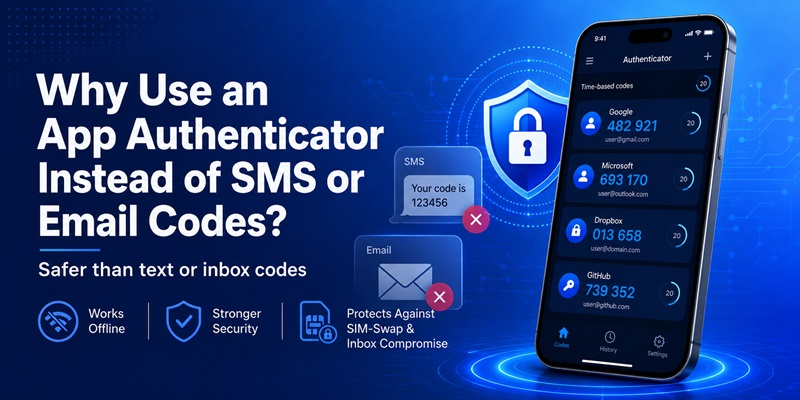
One of the biggest advantages of an authenticator app is that normal TOTP codes are generated locally. SMS codes depend on a carrier, a working phone number, and message delivery. Email codes depend on access to the inbox and the security of that email account. If either channel is delayed, unavailable, or compromised, login becomes harder.
An authenticator app is especially convenient while traveling. You can open the app and read the current code even if the phone has no cellular connection. That is useful for accounts you may need to access from a hotel, airport, laptop, or backup device. It also avoids situations where a verification text arrives late after the code has already expired.
This does not mean SMS or email verification is useless. A service may still use those methods for recovery or as a fallback. The practical goal is to choose the strongest factor the service supports while making sure you can recover your account if your primary device is lost.
Why protecting your email still matters
People sometimes search for an email authenticator expecting a universal app that protects every mailbox. In reality, the email provider decides which sign-in methods are supported. Many providers let you connect a standard authenticator app through a QR code, while others use their own push approval, passkeys, security keys, or device prompts.
Your primary email deserves special attention because password-reset links for many other accounts are sent there. If an attacker controls the inbox, they may be able to reset other passwords even when those services use strong credentials. Using an app authenticator for the email account, when supported, can therefore protect more than one login.
The strongest practical setup is layered. Use a unique email password, enable two-factor authentication, store recovery codes offline, and keep recovery contact information current. An app authenticator helps reduce dependence on SMS, but the full recovery chain still needs to be secure.
3. Google Authenticator vs Microsoft Authenticator: Which Is Better?
A simple option for standard verification codes
google authenticator remains one of the best-known choices for time-based codes. Google allows users to generate verification codes for supported accounts, and current versions can sync authenticator codes to a Google Account if the user chooses to use account syncing. It is also possible to transfer accounts when moving between devices.
For someone who mainly wants a clean list of codes, an app authenticator with minimal extra features can be easier to manage. The interface matters more as the number of protected accounts grows, so search, labeling, backup behavior, and device migration are worth checking before committing to one app.
A common mistake is assuming that the brand of the authenticator must match the account. In most cases, a website that supports standard TOTP can work with many compatible apps. The QR code contains the information needed by the app authenticator, so you are often free to choose the tool that fits your workflow.
Microsoft’s current focus is authentication
microsoft authenticator continues to support multi-factor authentication, one-time codes, sign-in approvals, and passwordless experiences for supported Microsoft accounts and organizations. An important change for anyone comparing older reviews is that Microsoft discontinued Authenticator password autofill in mid-August 2025, and passwords are no longer available there. Password-related workflows moved away from the authenticator app.
That change makes the comparison clearer in 2026. If your main need is approving Microsoft work or school sign-ins, an app authenticator that integrates with Microsoft identity can be convenient. If your priority is a vendor-neutral vault of TOTP codes, compare backup, export, cross-platform availability, and account recovery rather than choosing based only on brand recognition.
Neither product is automatically the best for every user. The right app authenticator is the one that supports your accounts, gives you a recovery path you understand, and does not force you into a workflow you will forget a year later.
4. Google vs Microsoft vs Proton vs Apple Passwords: Quick Comparison
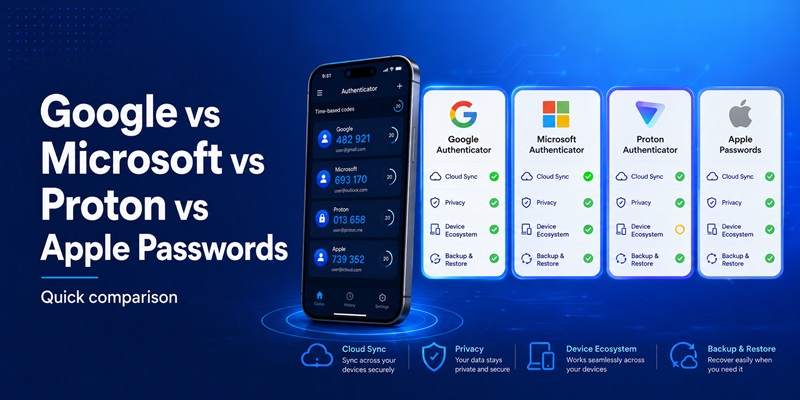
If you want to compare the most practical options at a glance, focus on platform support, syncing, recovery, and the type of sign-in experience you prefer. The table below summarizes how each app authenticator approach fits common use cases in 2026. Features can change, so verify the current support page before migrating a large set of accounts.
| Option | Best for | Platforms | Sync / backup | Offline codes | Key trade-off |
| Simple TOTP and Android-first users | Android, iOS | Optional code sync through a Google Account; manual transfer also supported | Yes | No official desktop app; intentionally simple feature set | |
| Microsoft | Microsoft 365, work/school accounts, push approvals | Android, iOS | Backup and account-recovery features are available; sign-in behavior depends on account type | Yes for TOTP | Password autofill was retired in 2025; strongest value is Microsoft sign-in integration |
| Proton | Privacy-focused and cross-platform users | Android, iOS, Windows, macOS, Linux | Encrypted sync with a Proton Account; iCloud sync on Apple devices; import/export supported | Yes | Newer product; sync setup differs by platform |
| Apple Passwords | People mainly using Apple devices | iPhone, iPad, Mac, Vision Pro | Verification codes can sync through iCloud Passwords & Keychain | Yes | Apple-centric; no native Android app for the same Passwords experience |
For a general app authenticator, Google is a straightforward default, Microsoft is especially useful in Microsoft environments, Proton emphasizes privacy and cross-platform control, and Apple Passwords offers the least friction for people already using Apple devices.
Google: Pros & Cons
| Pros | Cons |
| • Easy to use for standard TOTP codes • Generates codes offline • Optional sync across devices through a Google Account • Manual transfer is available if you prefer not to sync |
• No official desktop app • Fewer advanced desktop and organization features than some newer rivals • Users who avoid cloud-linked recovery may prefer a different app authenticator |
Microsoft: Pros & Cons
| Pros | Cons |
| • Strong fit for Microsoft personal, work, and school accounts • Supports sign-in approvals, MFA, one-time codes, and passwordless flows where available • App Lock can require device PIN or biometrics |
• Password autofill is no longer part of the app • More value for Microsoft-heavy users than for someone who only needs a neutral TOTP list • Enterprise behavior can depend on organization policies |
Proton: Pros & Cons
| Pros | Cons |
| • Available on mobile and desktop platforms • Can be used without creating an account • Supports import and export • Open source, with end-to-end encrypted sync when using a Proton Account |
• Newer than several established competitors • Sync method varies by platform, so migration planning deserves attention • Users who only need a few phone-based codes may not need the broader cross-platform feature set |
Apple Passwords: Pros & Cons
| Pros | Cons |
| • Verification codes are built into the Passwords experience on current Apple systems • Codes can autofill during sign-in • Passwords, passkeys, and verification codes are managed in one interface • Sync works across supported Apple devices through iCloud Passwords & Keychain |
• Best suited to an Apple-centered device setup • No native Android version of the same Passwords experience • Some users prefer keeping passwords and TOTP codes in separate tools rather than one credential system |
There is no universal winner. The practical question is which app authenticator gives you the right combination of compatibility, recovery, device coverage, and daily convenience without locking you into a setup you cannot restore.
5. Proton Authenticator, Apple Authenticator, and Other Options Explained
A newer privacy-focused option
proton authenticator is a newer option designed specifically for two-factor codes. Proton says the app can be used without creating an account, supports importing codes from several other authenticator apps, and can provide encrypted syncing when users choose to sign in. Proton also publishes the app as open source.
For users who want to move away from a single-device setup, migration tools are valuable. An app authenticator becomes difficult to replace if dozens of accounts are stored inside it and there is no clear export or transfer process. Before moving, verify the destination app’s import support and keep the old device available until every important account has been tested.
Privacy features are useful, but they do not replace basic recovery planning. Even with encrypted sync, save recovery codes for your most important accounts and confirm that you know how to regain access if the app authenticator is unavailable.
What people mean by Apple Authenticator
Apple’s built-in authenticator option is a common search topic, but Apple does not currently offer a separate app with that exact product name. On supported Apple devices, the Passwords app can store login information and generate one-time verification codes for websites and apps that support authenticator-based 2FA. Those codes can also be filled automatically in compatible sign-in flows.
Apple Account two-factor authentication is a separate system. When signing in to an Apple Account on a new device or browser, Apple can provide verification codes through trusted devices or trusted phone numbers. That should not be confused with storing a third-party site’s TOTP secret in Passwords.
If you are already deeply invested in Apple devices, the built-in workflow may reduce friction. If you regularly switch between operating systems, a cross-platform app authenticator may be easier to manage. The important comparison is not the label on the app; it is how well the tool fits the devices you actually use.
6. Steam Authenticator, Binance Authenticator, and Facebook Authenticator

Service-specific authentication can work differently
steam authenticator usually refers to Steam Guard Mobile Authenticator, which is a feature inside the Steam Mobile App. It adds a second layer of protection to a Steam account and can generate Steam Guard codes. Because this feature is tied to the Steam ecosystem, it is not simply a generic replacement for every other app authenticator you may use.
This is a useful reminder that the word “authenticator” can describe two different things: a general TOTP tool that holds codes for many services, or a service-specific security feature designed for one account ecosystem. When setting up a new login, follow the security page for that service instead of assuming every authenticator works in exactly the same way.
For gaming accounts with valuable inventories, purchases, or long histories, recovery information matters just as much as everyday sign-in. Keep the phone number, recovery method, and account email current so losing a device does not turn into a long recovery process.
Crypto and social accounts
binance authenticator is one of the authenticator options Binance references for app-based two-factor authentication. Binance also supports other security methods, and its current security guidance recommends authenticator apps or hardware keys over relying only on SMS for stronger account protection. For accounts holding financial value, an app authenticator should be paired with anti-phishing awareness, withdrawal protections, and a unique password.
facebook authenticator is another phrase that can be misleading. Facebook supports using third-party authentication apps to generate login codes, but users do not need a separate Facebook-branded authenticator app. During 2FA setup, Facebook can provide a QR code that you add to a compatible tool.
In both cases, save the recovery methods offered by the service. An app authenticator makes routine login stronger, but it should not become the only doorway back into the account. Store backup codes somewhere secure and separate from the phone that holds the primary authenticator.
7. Which Authenticator Should You Choose?
Start with compatibility and recovery
The best 2fa authenticator is not necessarily the one with the longest feature list. Start by checking whether it supports the accounts you actually use and whether you understand its backup and recovery model. If you have ten or twenty protected accounts, losing access to the app authenticator can affect a large part of your digital life at once.
Look for clear options to transfer, export, or restore codes. Some people prefer account-based sync because replacing a phone is easier. Others prefer a local-only setup because they want fewer cloud dependencies. Neither approach is perfect for everyone. The key is to know what happens when the device breaks, is stolen, or is replaced.
Also check whether the app lets you label accounts clearly. A long list of nearly identical usernames can become confusing. Good organization helps prevent entering the wrong code and makes it easier to audit old accounts that no longer need to remain in the app authenticator.
Think beyond the phone
Cross-platform support matters if you use both mobile and desktop devices. Some users want access only on a phone, while others want a synchronized app authenticator across a phone, tablet, and computer. Decide whether that convenience fits your risk model and daily workflow.
Security features such as biometric or device-lock protection can reduce casual access if somebody briefly handles your unlocked phone. Export controls are also important. If an app allows easy export, protect the export file carefully because it may contain the secrets required to recreate your codes.
Finally, consider the vendor’s update history and documentation. An app authenticator is part of your security infrastructure, so clear support pages, transparent migration instructions, and regular maintenance are more valuable than flashy extras. Choose a tool you can understand well enough to recover from a bad day.
Best authenticator by use case
A useful way to choose an app authenticator is to start with the environment you already use. The recommendations below are not absolute rankings; they match the strongest fit for each common need.
| Need | Recommended direction | Why it fits |
| Android | Google or Proton | Google is simple and familiar on Android; Proton adds desktop apps, import/export, and privacy-focused sync options. |
| Microsoft 365 | Microsoft | Best fit when you regularly approve Microsoft work, school, or personal account sign-ins and your organization uses Microsoft identity tools. |
| Apple | Apple Passwords | Built into current Apple platforms, syncs through iCloud Passwords & Keychain, and can autofill verification codes during sign-in. |
| Privacy | Proton | Open source, usable without an account, supports import/export, and offers end-to-end encrypted sync when a Proton Account is used. |
| Crypto | Trusted TOTP app; stronger hardware-backed method where supported | For exchange accounts, prefer an app authenticator over relying only on SMS. For especially sensitive accounts, consider a hardware security key or passkey if the service supports it. |
| Gaming | Steam Guard for Steam; general TOTP app for other services | Steam Guard is integrated into the Steam Mobile App and supports Steam-specific approvals, QR sign-in, and rotating codes. |
If you use several ecosystems at once, prioritize portability. A cross-platform app authenticator can be easier to maintain than separate tools for every device, while service-specific authenticators still make sense when they unlock native approval flows. Microsoft users may prefer Microsoft’s app for work sign-ins while a second general app authenticator handles unrelated TOTP accounts.
For crypto accounts, the goal is not choosing the most fashionable app authenticator. It is avoiding weak recovery habits. Save recovery keys securely, protect the email account linked to the exchange, and use a hardware-backed method when supported for especially sensitive accounts. For gaming, a service-specific tool such as Steam Guard is usually the most practical choice for Steam because it integrates directly with the platform.
8. How to Download Authenticator App Safely and Set It Up
Use official sources
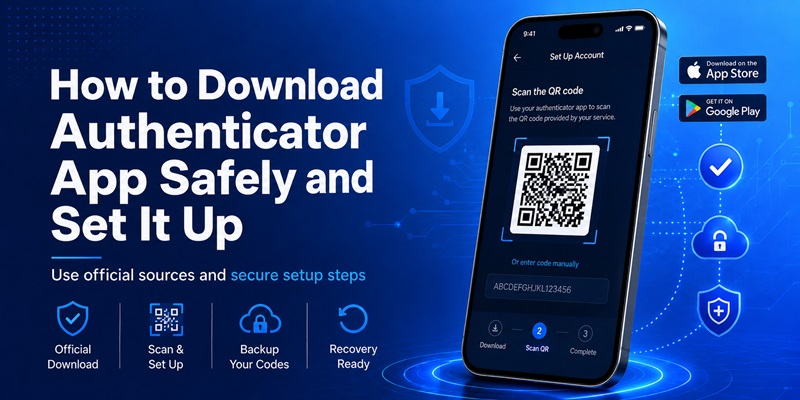
When people search download authenticator app, the safest starting point is the official website of the provider or the official app store on the device. Avoid random download pages, modified APK sites, sponsored lookalikes with unfamiliar developer names, and links sent through unexpected messages. An app authenticator can contain secrets that protect many accounts, so installing a fake version creates an unusually serious risk.
Before installing, confirm the developer name, app icon, store listing, and link from the vendor’s own support page. Keep the operating system and the app authenticator updated. If you are moving from an old authenticator, do not erase the old device until the migration is complete and several important accounts have been tested.
The phrase download authenticator app may also lead to many generic tools. Do not choose only by star rating. Read what the app says about backups, syncing, exports, account recovery, and supported platforms.
Set up one account at a time
A typical setup begins in the security settings of the account you want to protect. Enable two-factor authentication and choose the option for an authentication app. The service displays a QR code or setup key. Add it to your app authenticator, then enter the current code back into the website to confirm that setup works.
After confirmation, the service may provide recovery codes. Save them immediately in a secure location that is separate from the phone. Do not treat a screenshot in the same photo library as a strong backup. A password manager, encrypted offline storage, or a securely stored printed copy may be more appropriate depending on your situation.
Repeat the process account by account. When the app authenticator contains many entries, use clear labels and remove obsolete tokens only after you are certain the related 2FA setting has been disabled or moved. The safest migration is deliberate, not rushed.
9. Common App Authenticator Problems and How to Fix Them
The code is rejected
If a code from an app authenticator is repeatedly rejected, first confirm that you are using the entry for the correct account. Similar email addresses, work profiles, and duplicate labels can make it easy to select the wrong token. Next, check the device time. TOTP depends on time, so a phone with an incorrect clock can generate a code for the wrong window.
Set date and time to update automatically, reopen the app, and wait for a fresh code. Make sure you are entering the code on the real service website or app and that you have not left an old setup screen open. If you recently changed the 2FA configuration, the old app authenticator entry may no longer match the new secret.
Do not keep trying indefinitely if the service starts rate-limiting sign-in attempts. Use the official recovery process and verify that your account has not been changed unexpectedly.
You lost or replaced the phone
Losing the phone is the scenario that should be planned before it happens. If your app authenticator uses a supported sync or backup method, follow the provider’s restore instructions on the new device. If it does not, use the recovery codes or alternate authentication methods you saved when enabling 2FA.
If you still have the old phone, migration is usually easier. Transfer or export the accounts, confirm them on the new device, and test critical services before wiping the original. For highly important accounts, sign in and verify that the new app authenticator works rather than assuming the transfer succeeded.
When there is no backup, use each service’s account recovery process. Avoid anyone who claims they can bypass 2FA or asks for passwords, recovery codes, seed phrases, or remote device access. Real support processes may take longer, but they are safer than handing security credentials to a stranger.
10. Frequently Asked Questions About Authenticator Apps
Can one authenticator protect many accounts?
Yes. A general-purpose app authenticator can usually store TOTP entries for many websites and services at the same time. Each account has its own secret and its own rotating code. You do not normally need a different app for every service.
The main exception is when a company uses a service-specific approval system rather than standard TOTP. That is why Steam Guard and some enterprise sign-in tools may behave differently from a generic code list. Always follow the setup instructions shown by the account you are protecting.
As the list grows, organization and backups become increasingly important. An app authenticator that feels simple with three accounts can become difficult to manage with thirty if labels are unclear or migration options are limited.
Can authenticator codes work offline?
Standard time-based codes can usually be generated offline because the app authenticator already has the shared secret and uses the device clock to calculate the current value. Internet access is still needed for the website or app you are signing into, and some products may need connectivity for syncing or push approvals.
This offline behavior is one reason authentication apps are useful during travel. It also means that deleting and reinstalling an app can be risky if the secrets were not backed up or transferred. The ability to generate a code locally does not mean the account data will automatically return after an uninstall.
Treat the app authenticator like an important keyring. Keep the device protected, understand the backup method, and keep recovery codes separate.
Is an authenticator better than SMS?
For many accounts, a TOTP app authenticator is a stronger everyday choice than SMS because it does not depend on a phone number and is not exposed to SIM-swap attacks in the same way. However, TOTP codes can still be stolen through phishing if a user enters them on a fake page.
When available, passkeys and hardware security keys can provide stronger phishing resistance. The best option depends on what the service supports, but using any well-managed second factor is generally better than relying only on a password.
11. The Best Way to Use an App Authenticator Long Term
Create a recovery plan before you need it
The long-term value of an app authenticator depends on recovery. Every time you enable 2FA on an important account, save the recovery codes and record which authentication method is active. If you change phones, make migration part of the device-transfer checklist instead of dealing with it after the old phone has been erased.
Review the app authenticator once or twice a year. Remove entries for closed accounts only after confirming they are no longer needed. Update unclear labels, verify that backups still work as expected, and check that your most important accounts have at least one safe recovery route.
Do not store every recovery method in the same place. If the phone contains the app authenticator, the password manager, screenshots of backup codes, and the only recovery email, one lost or compromised device can create a single point of failure. Separation makes recovery more resilient.
Use stronger methods where they make sense
An app authenticator is an excellent baseline for many accounts, but security is not one-size-fits-all. For a bank, primary email, crypto account, developer platform, or business administrator login, consider passkeys or hardware security keys when the provider supports them. These methods can reduce the risk of real-time phishing compared with manually typed TOTP codes.
For ordinary accounts, a well-maintained app authenticator still offers a strong balance of security and convenience. The most important habits are using unique passwords, verifying login pages before entering codes, keeping devices locked and updated, and maintaining recovery information.
The best app authenticator is ultimately the one you can use consistently without sacrificing recovery. Choose a trustworthy tool, set it up from official sources, test your backup process, and treat the second factor as part of a broader account-security system rather than a magic shield. With that approach, an app authenticator can protect a large part of your online life without making everyday sign-in unnecessarily complicated.
12. Protect Your Accounts With Authenticator App
If you want one place to manage time-based verification codes, Authenticator App by Begamob is designed for everyday 2FA use across supported accounts. The product offers a clean app authenticator experience with biometric access, encrypted backup and sync, and code-import features designed to make setup and device changes easier.
Instead of waiting until you lose a phone or get locked out, set up a recovery plan while you still have access to every account. Add your most important services first, save their recovery codes separately, and confirm that your new app authenticator can generate the correct codes before removing any older setup.
Get Authenticator ℠ App
Add an extra layer of protection to your online accounts with two-factor authentication. Generate secure verification codes and protect your accounts whenever you sign in.